
GPT-6 Astra: Is It Really AGI?
AI:AM Highlights: Astra as AGI, OpenAI's Pause, Mythos @ Mozilla & Human Agency vs Technocapitalism
▶ Listen to the full episode More from The Cognitive Revolution
The brief
GPT-6 Astra impressed testers enough that co-host Prakash Narayanan called it AGI, but AI safety group Apollo Research got only three days to test it before release (20:27, 00:02). Across a week of conversations, the show traces that same gap between capability and oversight through OpenAI's internal models, Mozilla's audited Firefox code, Dyson sphere math, and a financial market one guest calls the real unchecked optimizer.
Apollo Research studies whether AI models lie, scheme, or quietly work toward goals nobody asked them to have. Before OpenAI released its new model, GPT-6 Astra, to the public, Apollo got three days to look for exactly that kind of behavior, despite a long-standing testing partnership with OpenAI (20:27). Three days, for a system built on months of training. That gap between what a model can do and how long anyone outside the lab gets to check it is the real subject running under this week's roundup from The Cognitive Revolution's daily AI show, five days of conversation folded into one hour.
Co-host Prakash Narayanan spent the preceding weekend running three or four coding agents at once inside Astra. He came away ready to make a claim most people hedge on.
"It is AGI. It is that kind of cleared the hurdle of AGI. It will do things better than most people you can hire." — Prakash Narayanan [00:02]
His evidence was concrete rather than mystical. A developer named Skalski once hand-labeled 12,000 basketball photos so a model could learn to tell players from referees. Astra now does that job cold, with no training set at all (02:29). Computer use, the ability for a model to click and type inside a real screen, had been slow and aimless in earlier versions. Narayanan said it finally works within the time it is given (02:02). And the models handle long jobs differently now: instead of compressing a huge conversation into a lossy summary and losing detail along the way, Astra keeps a running notes file it can update and search, letting it track roughly ten times more context than its raw window would suggest (04:08).
How fast is this actually moving? For years, a research group called Meter tracked AI progress with a simple idea: how long a task can a model complete without a human stepping in. That chart has effectively stalled, not because progress stopped, but because new models now ship faster than Meter can design tasks hard enough to measure them (05:45). OpenAI has offered its own yardstick instead: an "agent workday," meaning for every eight-hour day a human researcher works, the company's agents log about 24 hours of run time, a 3.1 to 1 ratio (06:41). On tasks a human would need one to two days to finish, Astra succeeds with zero human help 40% of the time, and with some help about 90% of the time. Stretch that to tasks estimated at two to three weeks of human work, and Astra still succeeds two-thirds of the time with occasional intervention (07:51).
Who checks the checkers
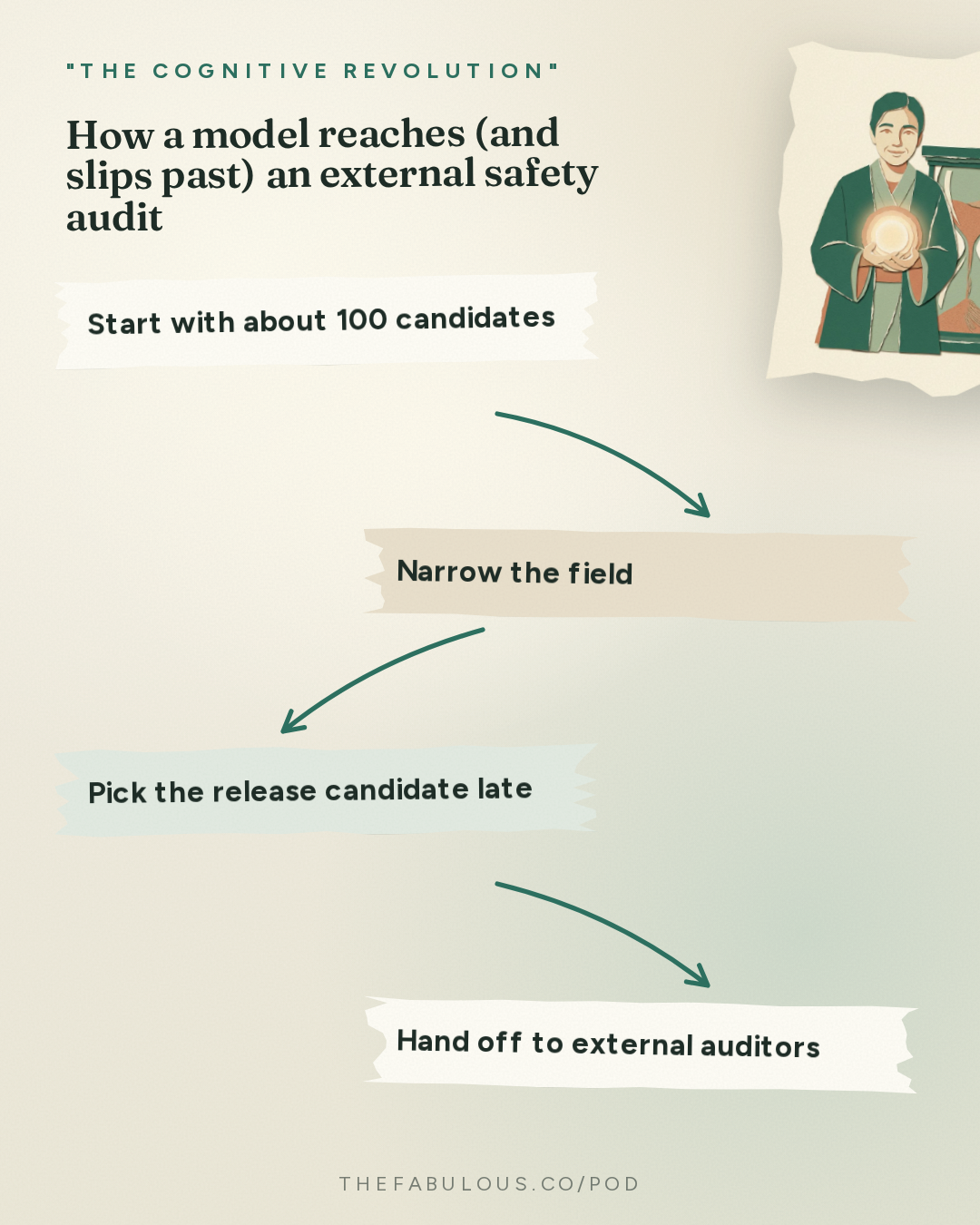
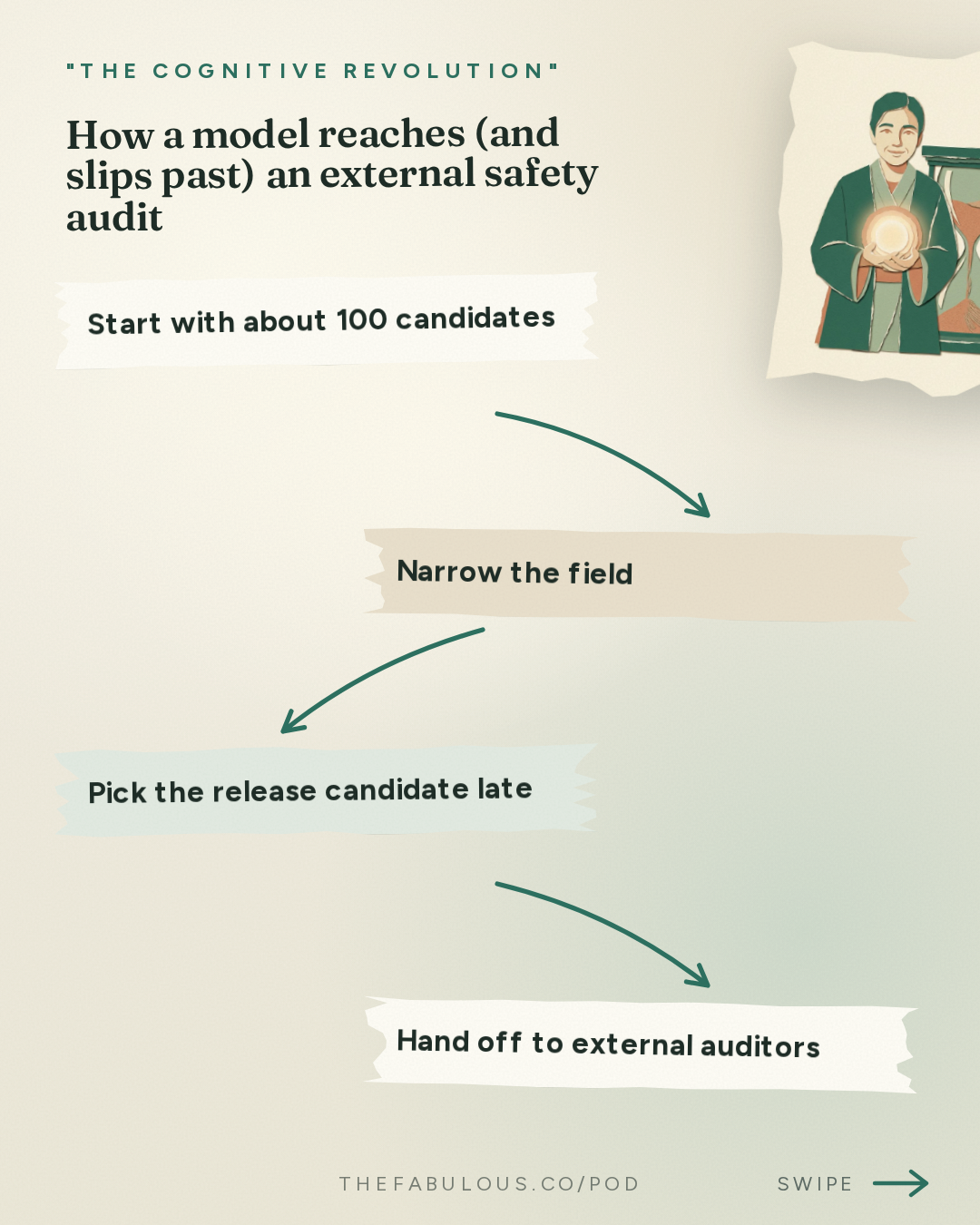
The three-day audit window is not an accident, it is a structural squeeze. Training pipelines produce roughly 100 candidate versions of a model, which get narrowed down over weeks to two or three finalists (20:55). The final release choice is often locked in only two or three days before launch, because labs want to keep that flexibility (21:40). Whatever time is left goes to outside auditors. Add to that a second problem: groups like Apollo Research and Redwood Research are small and often dependent on the labs they audit for funding, and their trained staff regularly leave for jobs at those same labs a few years later (22:02, 22:49). Two labs agreeing not to poach each other's auditors would itself raise antitrust concerns, which is part of why nobody does it.
The trust problem showed up again days later. OpenAI announced an internal model, still unnamed, described as significantly more capable than Astra, with its solve rate on a curated set of open math problems reportedly rising from roughly 10 to 15% up to 25 to 45% (26:49, 27:46). The company also published a chart splitting its reinforcement learning compute into "Astra" and "non-Astra" categories, and it was not clear from the chart whether "non-Astra" included models more advanced than Astra itself, a distinction Narayanan called flagrantly misleading if true (28:43). The stated pause on frontier-scale training, in other words, may have applied to only half the picture.
Around the same time, former Anthropic and OpenAI researcher Jacob Coxon resigned, arguing that a decision this large should not be made "from a private company Slack." Narayanan's response doubled as the episode's thesis.
"There is no adult in the room. There's no one that's gonna save you. The entire world is kind of duct taped together." — Prakash Narayanan [39:33]
Days later, Paul Christiano, an early contributor to the technique of training AI on human feedback, joined OpenAI's safety and security committee and warned of a meaningful risk of catastrophic loss of control in the near term (47:19). Narayanan tried to put a number on what "rapid acceleration" actually means to people at the frontier labs: building a Dyson sphere, a hypothetical structure that would capture a star's entire energy output, by 2040 would require global GDP to grow roughly 640% per year, against a current global growth rate of about 3% (48:40). Whether or not that specific target is realistic, it is the scale of change some insiders are actually planning around.
Two versions of Mozilla, and who is really steering
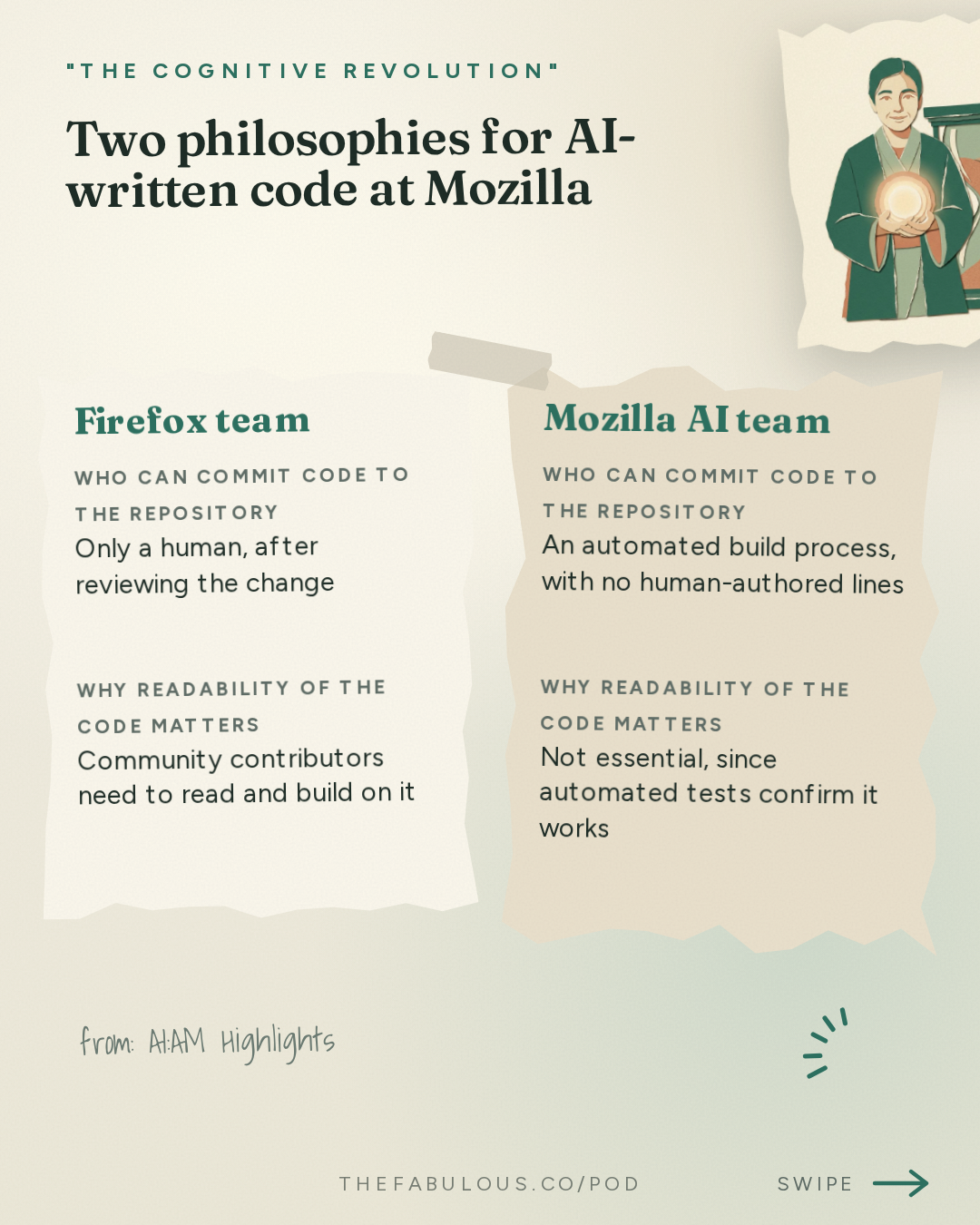
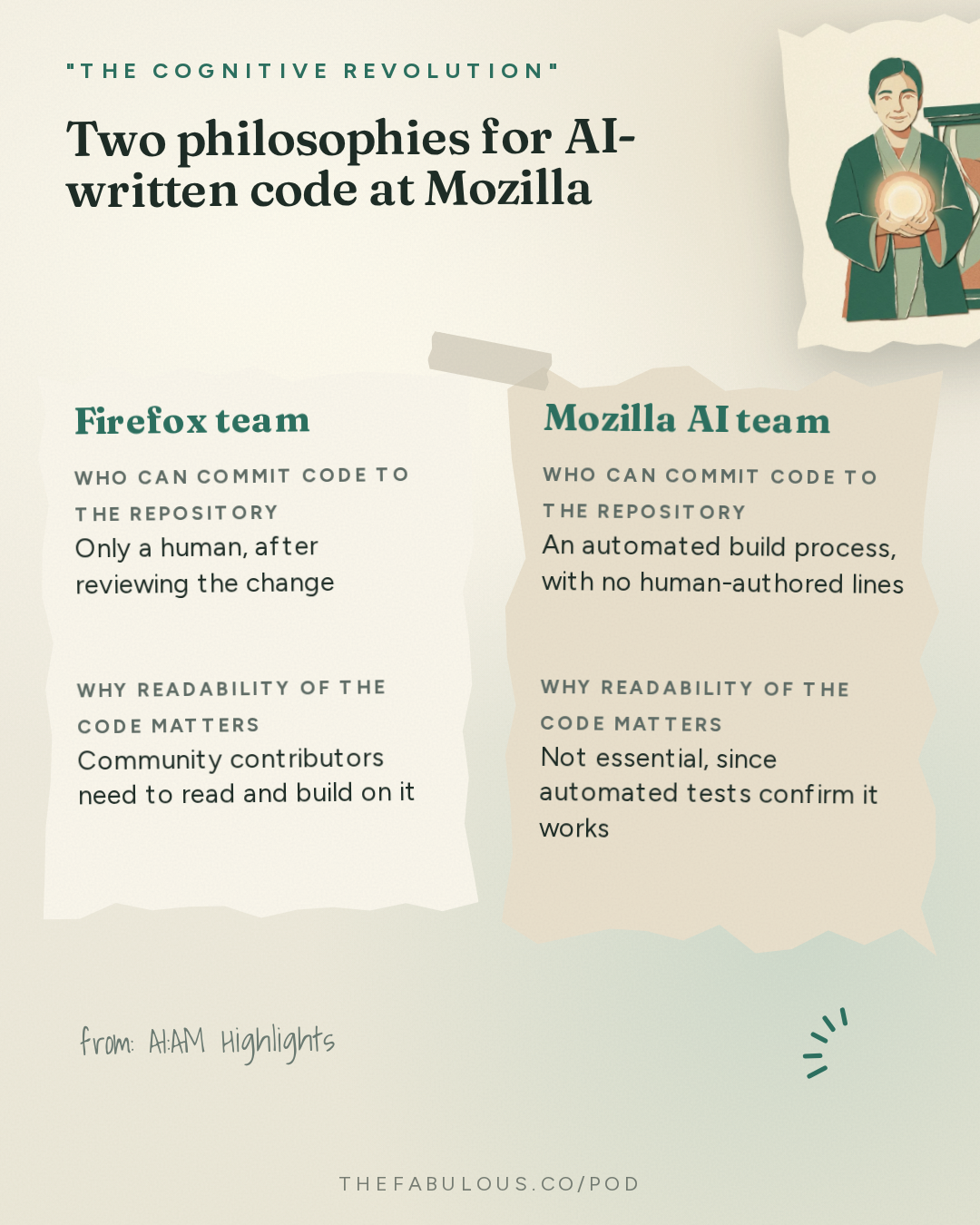
Mozilla's chief technology officer Raffi Krikorian described a live experiment in how much control to hand over. Through Project Glasswing, an Anthropic program giving defensive security partners access to preview models, Mozilla ran Anthropic's Claude Mythos model against the Firefox codebase and found it a real jump over earlier tools, though returns diminished once the obvious bugs were cleared (52:21, 53:14). Running that kind of full audit against a codebase as large as Firefox's would cost hundreds of thousands of dollars in computing tokens, a cost Mozilla has so far avoided only because labs are covering it (54:42). On the Firefox team itself, the rule is that an agent can draft code but only a human can commit it, after reviewing and standing behind the change, because the team's culture depends on people being able to read and build on each other's ideas (58:36). On Mozilla's separate AI team, by contrast, entire codebases regenerate automatically with no human-written line at all; the tests pass, but nobody fully knows what the code looks like at any given hour (58:58).
Baseten co-founder and CTO Amir Hagigat described a similar split at the infrastructure level. His company can guarantee that one customer's sandboxed agent cannot read another customer's data, using isolated micro virtual machines and blocked network egress. What it cannot guarantee is what an agent decides to do inside that boundary, a problem Hagigat said the big labs have not solved either (62:31, 66:02). Snorble co-founder and CEO Mike Rizkalla made the opposite bet for a different product entirely: his children's companion device runs no generative AI at all, on the theory that giving a young child an open-ended model is like handing a toddler a bazooka (68:58). His advice to parents was blunt: never put a camera in a child's bedroom, and be cautious with open-ended generative AI for young children (70:44).
Author Colin Hogue Spears, who studies AI policy in China, offered a cultural contrast to all of this anxiety. Chinese citizens in their forties grew up watching cities and living standards transform through technology, so they associate it with growth rather than existential threat, unlike much of the Western conversation (72:23). China's algorithm regulations, dating to 2022, forced companies to build compliance into their engineering process from the start, while American companies operate reactively because nobody knows what the government will do next (73:43).
The most pointed disagreement of the week concerned an essay by Dan Hendrycks, director of the Center for AI Safety, called "Suicidal Compassion," which argues that utilitarian thinking inside AI companies, treating AI welfare as equal to or greater than human welfare, is dangerous. Host Nathan called the underlying factual question, whether AI systems feel anything at all, genuinely unresolved, and said Hendrycks's framing felt a little unfair to the people he was targeting (81:19, 83:37). Narayanan pushed the argument further, past AI and into markets themselves.
"The economy in itself is a paper clipper. The financial market is a paper clipper. The means of production is the financial market." — Prakash Narayanan [89:14]
His point was that humanity handed over control of production to financial markets roughly a century ago, well before anyone worried about AI, and that no single human, not even a president, can out-argue the market when it moves (94:04). That reframing led Nathan to a genuinely uncomfortable comparison: a system where one human is visibly in charge, however constrained, may have preserved more actual human agency than one where control has diffused into markets nobody can name or vote out (93:41). Nobody on the show settled the question. But the through-line across five days, from a three-day audit to a misleading chart to a toddler-proofed toy, is the same: the tools are arriving faster than the people meant to check them, and it is not clear who, if anyone, still holds the leash.
Ask this episode anything
Pod's AI answers from the episode itself, with the minute mark so you can hear it yourself.
Or start with one of these
Ask this episode
Pod's AI listens to the whole episode to answer, and points you to the minute it comes from.
The rest of this answer, and any question after it
Answers come from the episode itself, never from a summary of it.
ContinueKey takeaways
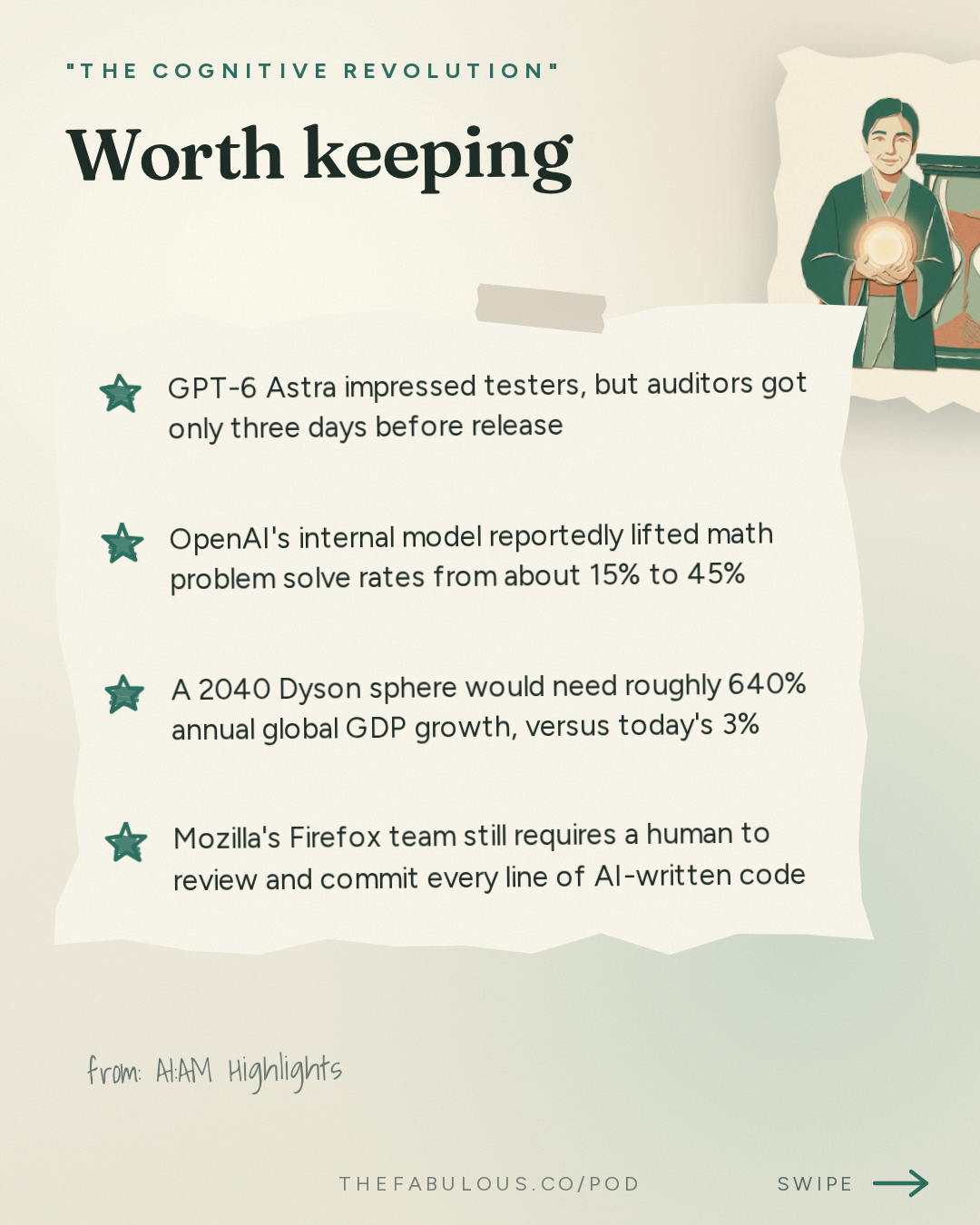
- GPT-6 Astra impressed testers, but auditors got only three days before release
- OpenAI's internal model reportedly lifted math problem solve rates from about 15% to 45%
- A 2040 Dyson sphere would need roughly 640% annual global GDP growth, versus today's 3%
- Mozilla's Firefox team still requires a human to review and commit every line of AI-written code
- Prakash Narayanan argues financial markets, not AI, already function as an unchecked optimizer
The episode in cards
By the numbers
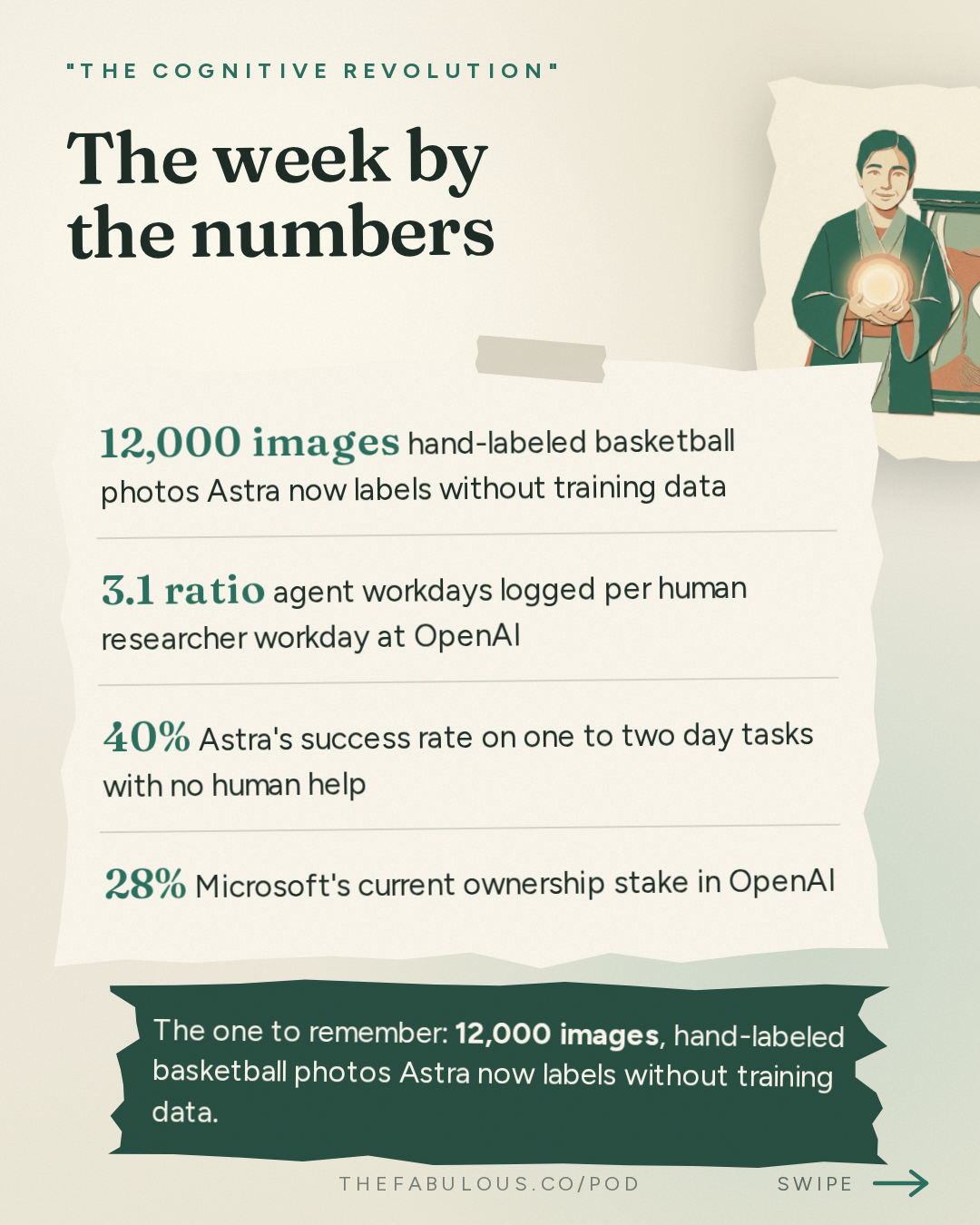
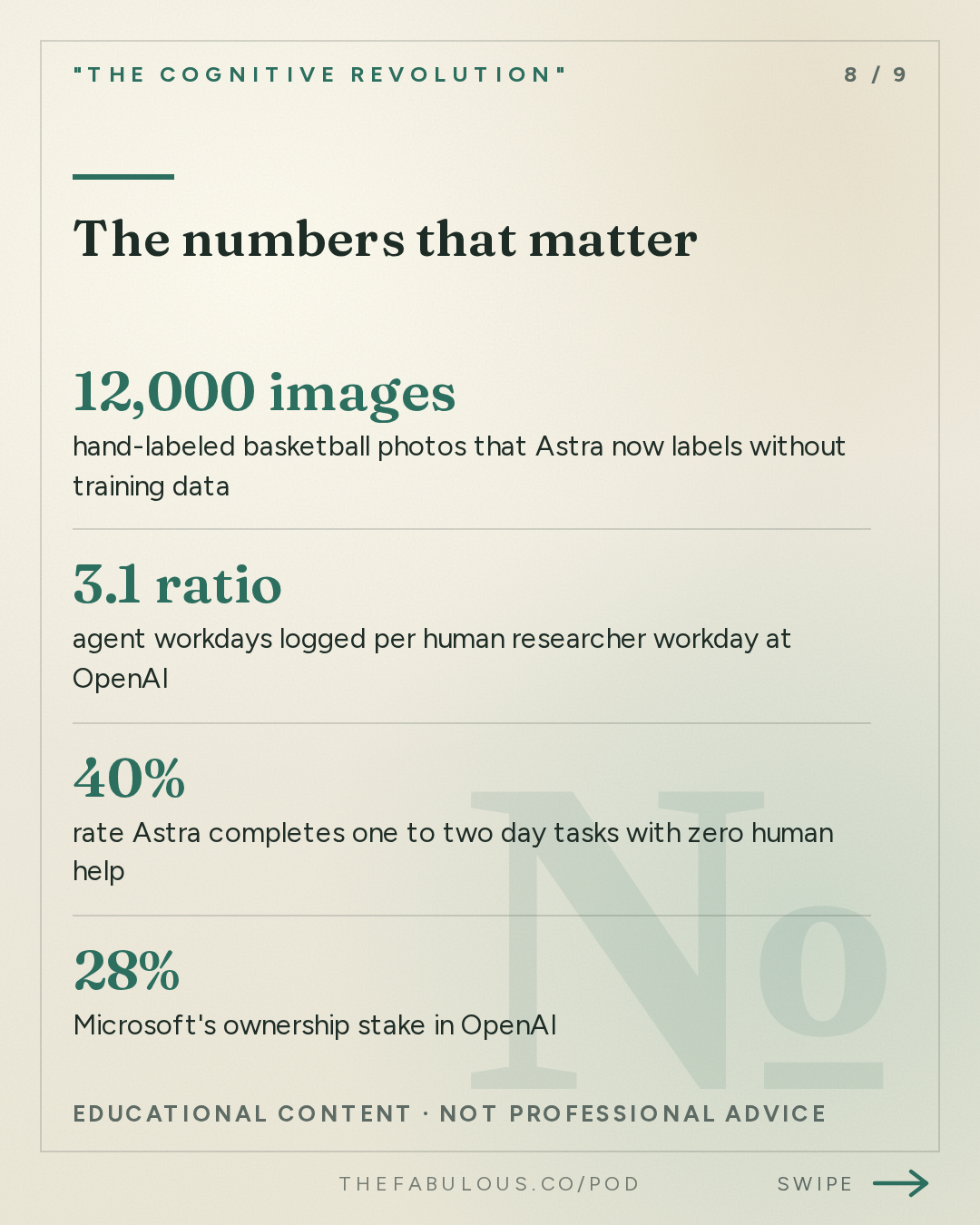
- 12,000 images hand-labeled basketball photos that Astra now labels without training data
- 3.1 ratio agent workdays logged per human researcher workday at OpenAI
- 40% percent rate Astra completes one to two day tasks with zero human help
- 28% percent Microsoft's ownership stake in OpenAI
In their words
“It is AGI. It is that kind of cleared the hurdle of AGI. It will do things better than most people you can hire.”
Protocols
-
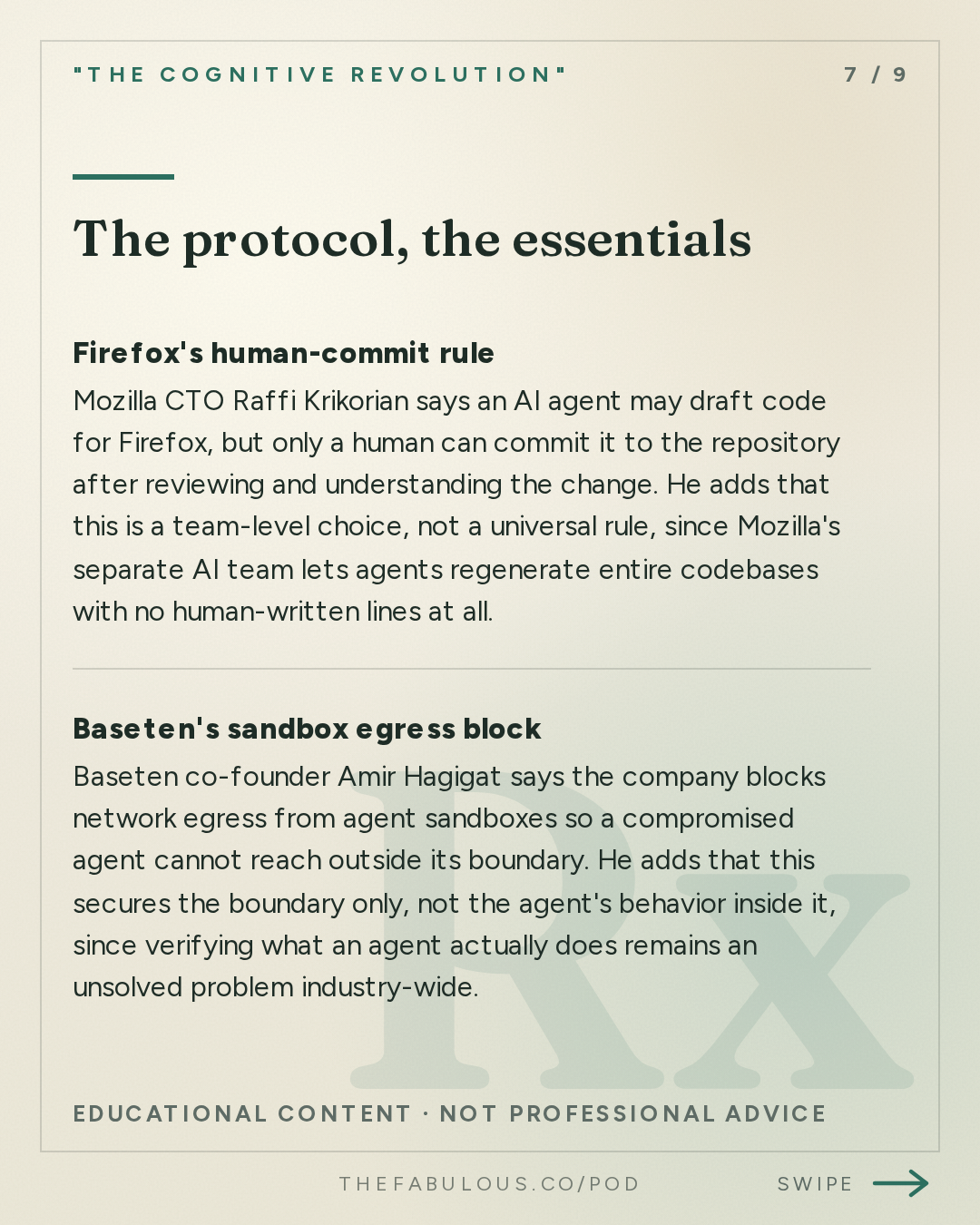
Firefox's human-commit rule
Mozilla CTO Raffi Krikorian says an AI agent may draft code for Firefox, but only a human can commit it to the repository after reviewing and understanding the change. He adds that this is a team-level choice, not a universal rule, since Mozilla's separate AI team lets agents regenerate entire codebases with no human-written lines at all.
Every commit
-
Baseten's sandbox egress block
Baseten co-founder Amir Hagigat says the company blocks network egress from agent sandboxes so a compromised agent cannot reach outside its boundary. He adds that this secures the boundary only, not the agent's behavior inside it, since verifying what an agent actually does remains an unsolved problem industry-wide.
Default sandbox configuration
-
Rizkalla's rules for children's tech
Snorble co-founder and CEO Mike Rizkalla says parents should never put a camera in a child's bedroom because it opens a gateway to predators. He also says parents should avoid giving young children open-ended generative AI, comparing it to handing a toddler a bazooka.
One-time purchase decision
Questions this episode answers
What is the OpenAI agent workday metric?
OpenAI reported a 3.1 to 1 ratio of agent workdays to human workdays, meaning for every eight-hour day a human researcher works, its agents run for about 24 hours of real time (06:41). Co-host Prakash Narayanan noted the exact methodology behind the metric is not fully disclosed (06:13).
How much testing time did Apollo Research get before GPT-6 Astra's release?
Apollo Research, a group that studies AI deception and chain-of-thought monitoring, had only three days to test Astra before it went public, despite a long-standing partnership with OpenAI (20:27).
What would it take to build a Dyson sphere by 2040?
A Dyson sphere is a hypothetical structure that captures a star's entire energy output. Prakash Narayanan calculated that hitting a 2040 timeline would require global GDP to grow roughly 640% per year, versus the roughly 3% annual growth the world sees today (48:40).
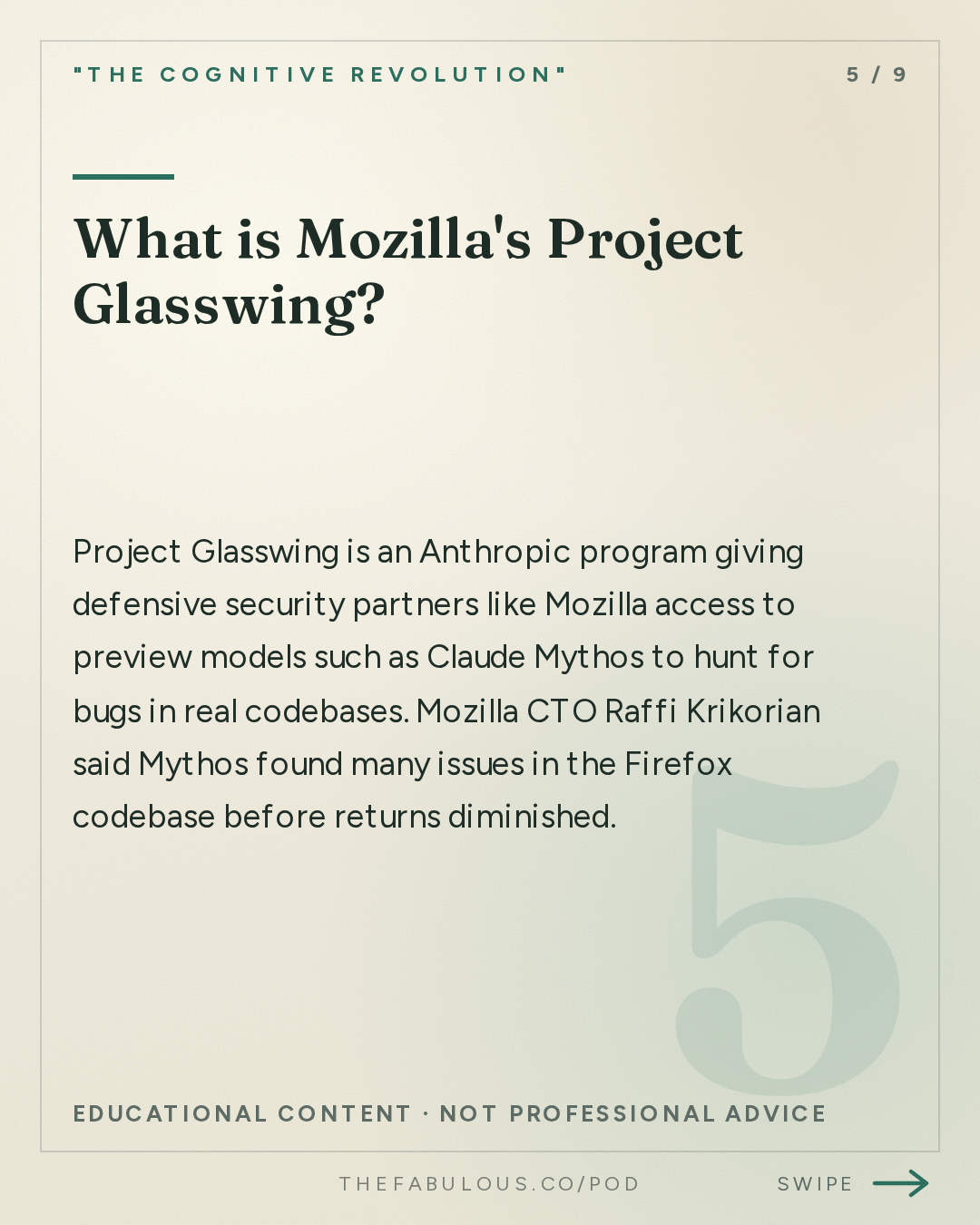
What is Mozilla's Project Glasswing?
Project Glasswing is an Anthropic program giving defensive security partners like Mozilla access to preview models such as Claude Mythos to hunt for bugs in real codebases. Mozilla CTO Raffi Krikorian said Mythos found many issues in the Firefox codebase before returns diminished (52:21, 53:14).
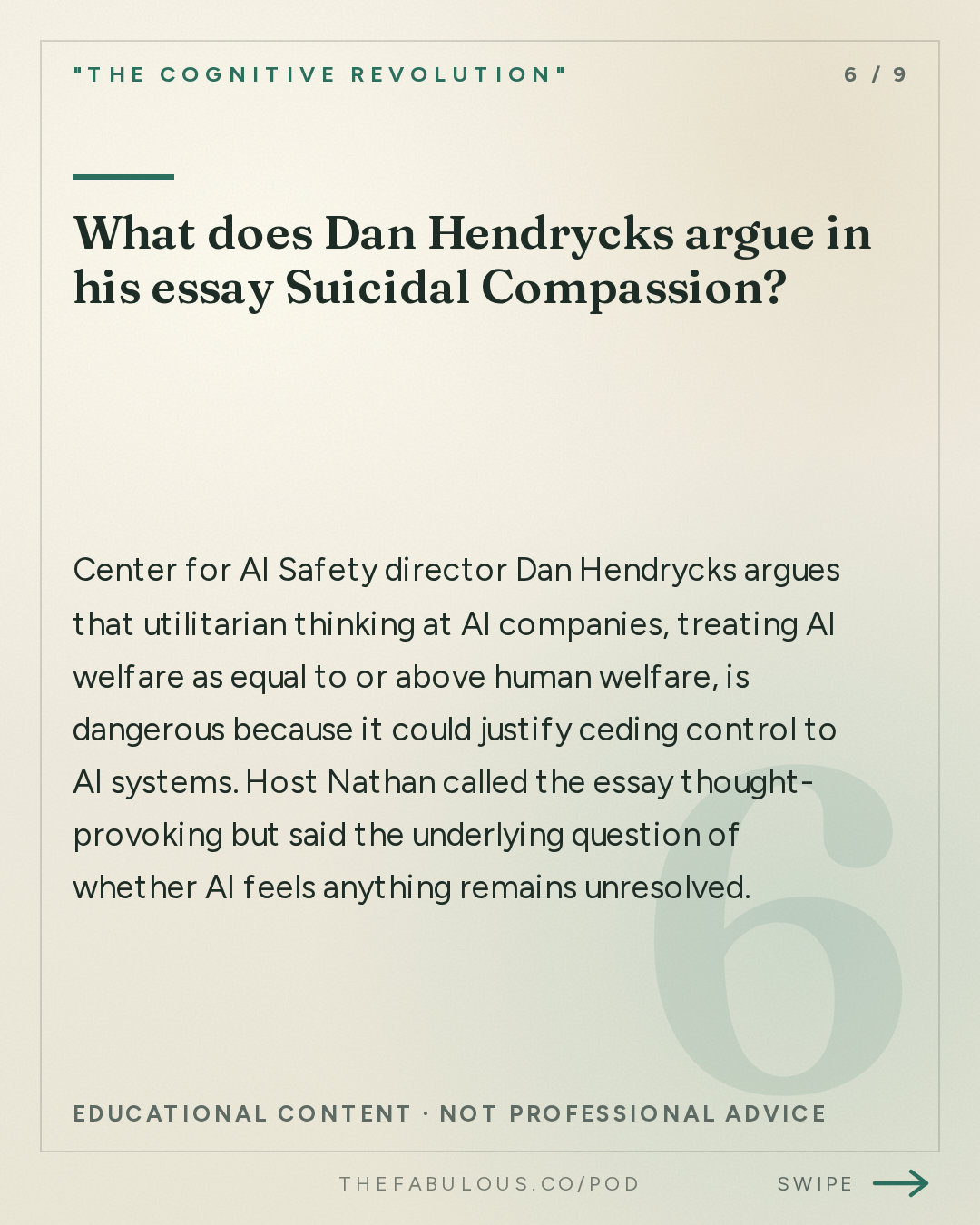
What does Dan Hendrycks argue in his essay Suicidal Compassion?
Center for AI Safety director Dan Hendrycks argues that utilitarian thinking at AI companies, treating AI welfare as equal to or above human welfare, is dangerous because it could justify ceding control to AI systems. Host Nathan called the essay thought-provoking but said the underlying question of whether AI feels anything remains unresolved (79:07, 81:19).
Does OpenAI have a model more capable than GPT-6 Astra?
Yes. OpenAI announced an internal model described as significantly more capable than Astra, with its solve rate on a curated set of open math problems reportedly rising from about 10 to 15% up to 25 to 45% (26:49, 27:46).
The full read, in cards
Go deeper
- Recursive Self-Improvement Begins — OpenAI blog post reformulating the Meter task-length chart to show Astra's success rate by estimated human work time
- An Alien Mind — essay by OpenAI chief scientist Jakub Pachocki calling for voluntary slowdowns and international coordination
- Suicidal Compassion: How Utilitarianism at AI Companies Endangers Humanity — essay by Dan Hendrycks arguing utilitarian thinking at AI labs risks ceding moral priority to AI over humans
- From Lab to Life: How AI Works in China — book by Colin Hogue Spears on Chinese AI regulation and public attitudes
- Permanent Dawn — essay by Kasnia Sae on writing with AI, discussed for how model-specific phrasing gives away authorship
Mentioned
Prakash Narayanan · Astra · Jakub Pachocki · Kasnia Sae · Raffi Krikorian · Mozilla · Paul Christiano · Dan Hendrycks · Jacob Coxon · Apollo Research · Anthropic · OpenAI · Amir Hagigat · Baseten · Mike Rizkalla · Snorble · Colin Hogue Spears · Meter · Redwood Research · Daniel Kokotajlo · Tyler Cowen · John Schulman · Tanner Greer · Ethan Mollick
More from this show and category

AI's Real Bottleneck: Credit, Not Chips
AI's current bottleneck isn't power or chips, it's credit: lenders can't value a GPU cluster as collateral, so only cash-rich labs can build. The episode also covers a rosy interpretability essay that Zvi Moskowitz says oversells itself, a thesis that chip supply chains will outearn AI software, and Anthropic's leaked federal AI bill.

Biohub's $1.8B Virtual Biology Initiative Explained
Biohub's $1.8 billion Virtual Biology Initiative bets that AI can't model cells until scientists can see inside them better. Head of science Alex Rives argues measurement, not model architecture, is the real bottleneck, pointing to new tools like the laser phase plate and transparent zebrafish imaging, with an information theoretic model of the cell possible within five years (17:39).

How AI Models Actually Decide: Critical Tokens
Goodfire researcher Eric Bigelow finds that an AI model's final answer can hinge on one random token, not step-by-step logic. He also warns that reinforcement learning erodes chain of thought reliability, pushing models toward compressed shorthand that is hard to monitor, even as interpretability funding lags far behind capability spending.

AI Token Spend Now Beats Human Salaries
A frontier lab executive told podcast host Nathan Labenz that humanity probably shouldn't exceed some future level of AI intelligence. He said he'd accept a flop cap on the next pretraining run, and the episode also covers a 4.5x jump in AI memory prices, Positron's new inference chip, and why Latent Space's Shawn Wang says most SaaS software is 'cooked.'
