ADHD Daily Task OrganizerFocus & ADHD · ~10 min
About this template · Updated September 2026
Junebugging has an author, and it is not a productivity brand. The name and the method come from a Tumblr user who posts as jumpingjacktrash, in a 2018 reply to someone describing how cleaning with ADHD turns into a trail of half-finished chores. Nothing on this page comes from them or carries their blessing. It is a separate practice tool, built around an idea they gave away for free.
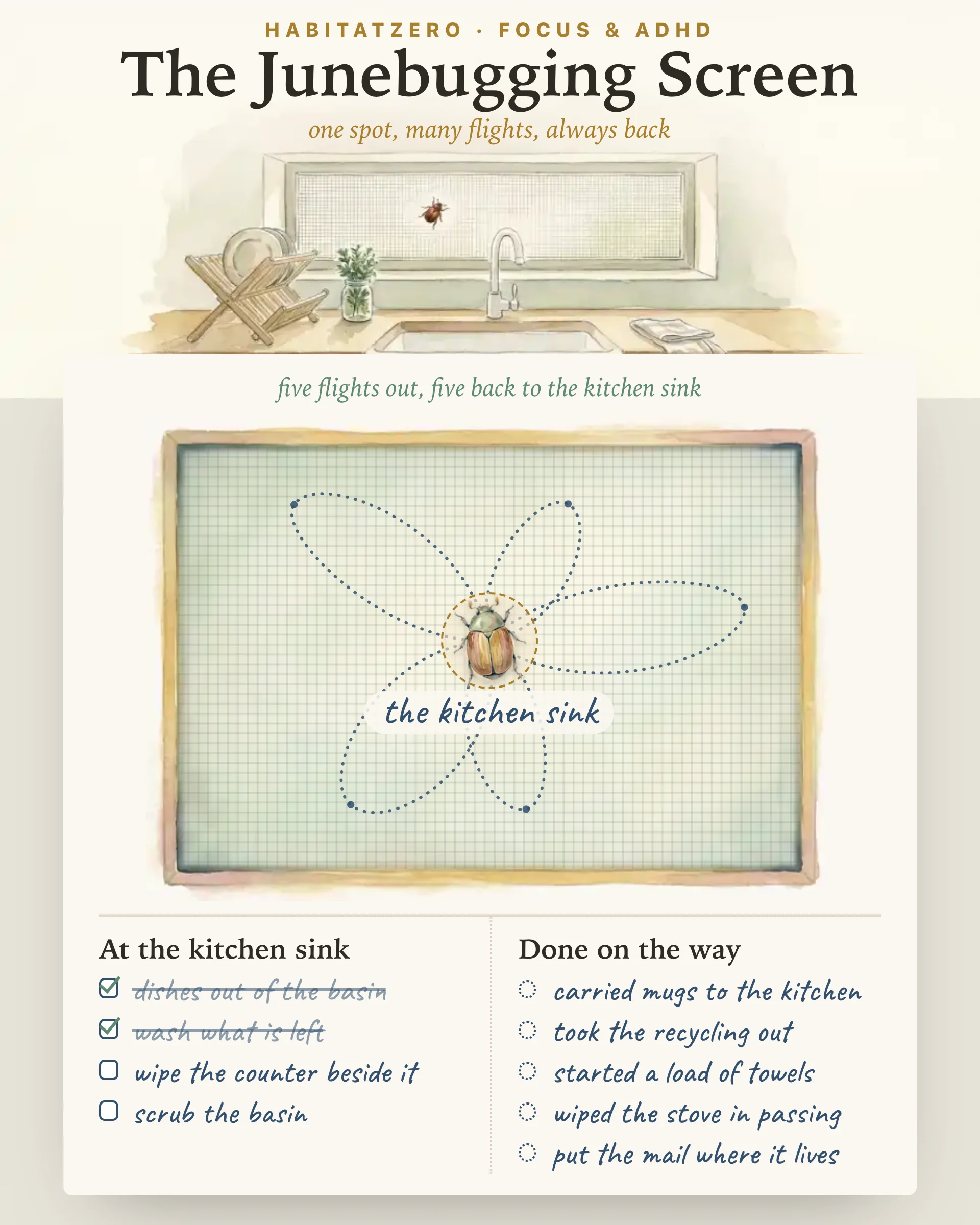
Their image is a June bug working at a window screen. The beetle is stubborn and has almost no focus. It bumps the mesh, swings off across the porch, circles the lamp, and then there it is again on the same square of screen. It never holds still, and it never really leaves.
Choose one location you think you can make a dent in today, and be strict about how small it is. The bathroom sink, not the bathroom. Within minutes you will carry a mug to the kitchen, notice the recycling, and find yourself wiping the stove. Junebugging does not ask you to prevent that. It asks that when you notice you are somewhere else, you go back to the sink. Repeat until the spot is done, you are bored, or the day is over. The original post pictures an imaginary bungee cord between you and the spot.
What makes this kinder than being told to focus is where it puts the effort. You stop policing every impulse and spend that energy on one repeatable move, the return. The detours are usually real chores anyway, so the rooms around your spot get cleaner as a side effect.
The sheet is a painted window screen. Tap a spot, or write your own, and it is inked at the center of the mesh with the beetle sitting on it. Underneath, list two or three small jobs that would make that spot look finished. Six is the most it will hold, because a spot with fourteen jobs is a room in disguise.
Then go clean. When you catch yourself elsewhere, tap what you were doing: took the trash out, started a load of laundry, answered a message. The beetle flies to the end of a fresh dotted flight, and the detour is written into a column called Done on the way. One button remains, and it says back to the kitchen sink. Press it, walk back, and the loop closes.
Each flight is drawn from its place in the order and the words you gave it, so no two sessions leave the same drawing. After a while the screen looks like a scribbled flower, every petal leaving one point and coming home to it. The status line keeps the only count that matters, in words: five flights out, five back. When every job at the spot is ticked, a card tells you the spot is clear.
Nobody has run a trial on junebugging. It is folk wisdom from someone who lives with ADHD, passed along because other people recognized themselves in it.
Parts of it rest on sturdier ground. The instruction "when I notice I have drifted, I go back to the sink" has the shape of what psychologists call an implementation intention, an if-then plan that ties a cue to a response decided in advance. Peter Gollwitzer's review of that research found that plans in this format help people reach the goals they set, partly because the response is handed to the cue instead of being decided in the moment.
The method is also realistic about attention. A 2018 review from King's College London argues that frequent, unplanned mind wandering is central to how ADHD is experienced, not an occasional lapse. A cleaning plan that only works if your mind stays put is a plan built for someone else. And the rhythm of anchor, drift, notice, return will be familiar to anyone who has tried focused attention meditation, where you rest attention on a chosen object and coming back is treated as the practice, not as the failure. That is a resemblance, not proof. This page is a way to practice a cleaning habit. It does not assess, diagnose or treat anything.
Shrink the spot until it feels almost silly. If the desk stalls you, make it the left half of the desk.
Log the unflattering detours too. Ten minutes on your phone is still a flight, and the point of writing it down is the trip back, not a clean record.
Stop when you stop. An unfinished spot with seven returns is a better afternoon than a perfect plan you never started.
Reach for it on days when you have energy but no aim, when you would clean happily if you could only stay in one room. If you cannot start at all, The Shrinker is made for cutting a first move down to size. If you would rather follow a sequence than roam, the Room Reset Planner lays one room out in five-minute moves, and the Tiny-Win Cleaning Checklist has the ticks written for you.
The beetle never gets through the screen. It just keeps turning up at the same square, and for a sink full of dishes, turning up is enough.
Junebugging is a way of cleaning that expects your attention to wander. You choose one small, specific spot, such as the bathroom sink, and every time you notice you have drifted off to something else, you go back to it. The name comes from a June bug at a window screen, which flies off in loops and keeps turning up on the same patch of mesh.
A Tumblr user who posts as jumpingjacktrash described it in 2018, replying to a post about how cleaning with ADHD becomes a chain of abandoned chores. The interactive screen on this page was made separately, without their involvement or approval, so the idea has something to be practiced on.
There are no studies of junebugging itself, so nobody can promise that. It was written by someone with ADHD, and many people with ADHD say it suits them because it plans for distraction instead of forbidding it. The return step resembles an if-then plan, a format with solid research behind it for following through. Treat it as a cleaning habit to try, not as treatment.
Small enough to finish in one session. The original advice is the bathroom sink, not the bathroom. If a spot needs more than six small jobs before it looks done, it is really several spots, so split it and junebug one piece today.
Yes. This page lets you look over the screen and a sample session at no cost. To run your own session and keep your spot, jobs and flights between cleaning days, personalize it in HabitatZero, which is also free.
By the team behind Fabulous, the science-based self-care app used by over 30 million people.