ADHD Daily Task OrganizerFocus & ADHD · ~10 min
About this template · Updated September 2026
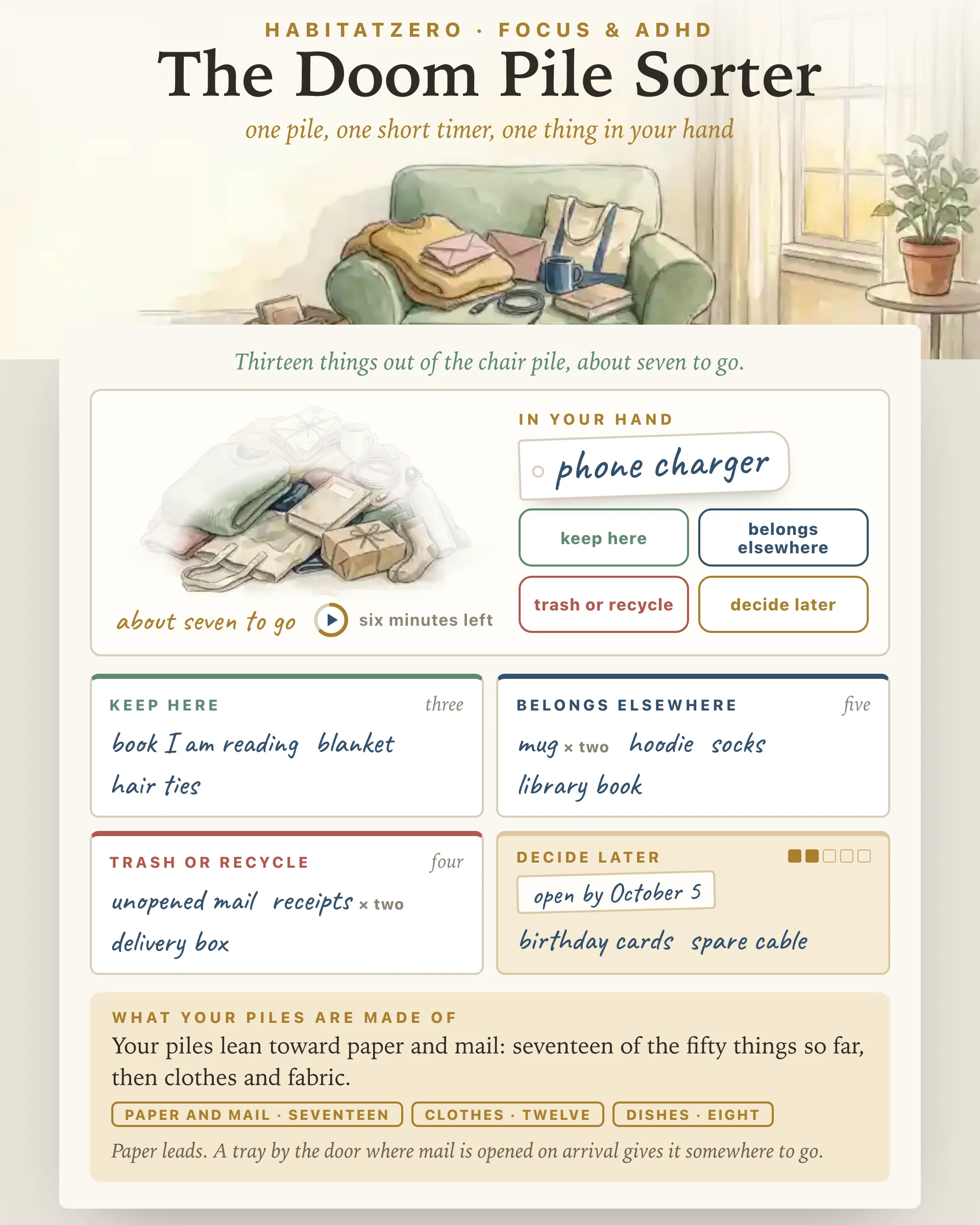
Every home has a spot where things go to wait. The armchair that stopped being a chair sometime in spring. The corner of the kitchen counter. The box you swept everything into before friends came over, still sitting in the hall. In ADHD circles this has a name: the doom pile, where DOOM stands for didn't organize, only moved. A doom box is the same thing with cardboard walls. The phrase has no single creator. It spread through ADHD forums and social media, so there is nobody to credit.
Putting one thing away is a small chain of decisions. What is it, do you still want it, where does it live, is that place full, and are you willing to walk there right now. Moving everything to one spot skips the whole chain in a single motion, and the surface you needed is clear in seconds. In the moment, that is a reasonable trade. The cost comes later, when the heap has to be decided all at once and your brain looks at it and sees forty questions instead of one.
So the job is not tidying in general. It is answering the postponed questions, one object at a time, with as little friction as possible.
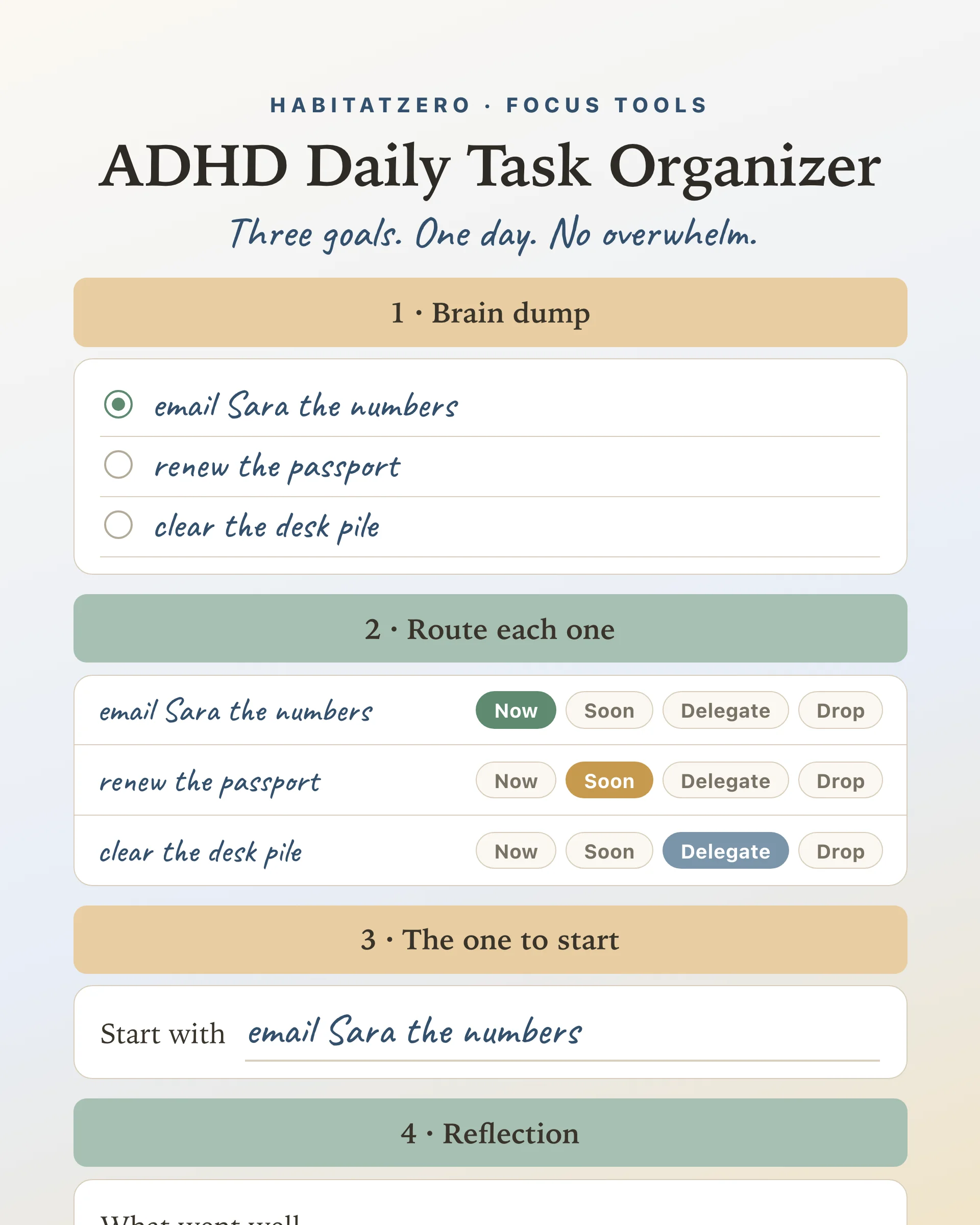
Start by telling the sheet which pile you are facing, from the chair to the doom bag, and roughly how many things are in it. Then tap the ring: ten minutes by default, draining without a sound.
Pick up one thing. Tap the name that fits, or write two or three words, and it sits in your hand on a paper tag. Now it gets exactly one of four places:
Each tap sinks the painted pile a little while a faint outline of where it started stays behind. The line at the top keeps count in words, as in twelve things out of the chair pile, about eight to go.
Below the trays, a note keeps track of what your piles are made of across every sort. After a few piles it will tell you that yours lean toward paper, or clothes, or cables, and suggest a landing spot for that kind of thing. That note is the part that stops the next pile from forming.
Nobody has studied doom piles under that name, so treat everything here as a practice tool rather than a treatment.
Research does describe the ground they grow on. In a small study of university students, it was inattention, rather than impulsivity, that went along with general procrastination, and the authors called the result preliminary (Niermann and Scheres, 2014). A DePaul University team found that people who habitually put things off also reported more clutter (Ferrari and colleagues, Current Psychology). That was a survey, so it shows the two travel together, not which one drives the other.
The timer has a reason too. A review of timing research found consistent differences in how people with ADHD judge and reproduce stretches of time, from seconds to minutes and longer (Noreika, Falter and Rubia, 2013). A ring you can see does the estimating for you, so ten minutes stays ten minutes instead of drifting into a vague later.
A doom pile is also not hoarding disorder, which the NHS describes as a mental health condition where getting rid of things feels very difficult even when it is affecting your life. If that sounds closer to home than a crowded armchair, talk to a doctor. A sorter is the wrong tool for it.
Pick the smallest pile you can see. A chair beats a room.
Leave the decide-later box alone during a session. It exists so you can keep moving, and reopening it mid-sort brings back the stall it was meant to prevent.
Batch the walking. Carry everything bound for the bedroom in one trip, then everything for the kitchen in the next.
Stop when the ring runs out if you want to. A pile that is half gone is half gone, and the next session starts smaller.
Open it when a surface has quietly turned into storage, or right before you tip the whole heap into a bag and call it done. If you keep wandering off halfway through, The Junebugging Screen turns coming back to one spot into the whole method. For a drawer or closet where the real question is whether to own things at all, the Decluttering Checklist stamps each item keep, donate or toss. And when a whole room needs a reset rather than one pile, the Room Reset Planner breaks it into five-minute moves.
The pile got there one quick move at a time. It can leave the same way.
It is a heap of mixed things that were moved off a surface instead of being put away. DOOM is usually read as didn't organize, only moved, a phrase that grew out of ADHD communities online and has no single author.
A doom box is the same habit with walls: a box, basket or bag where everything gets swept in a hurry, often right before guests arrive. It hides the mess without deciding anything, so it tends to fill up until someone sorts it.
Putting one object away takes a chain of small decisions, and for many people with ADHD starting that chain is the hardest part. Moving everything into one heap clears the surface in a single step and postpones every decision. People without ADHD make them too, and having one is not a diagnosis.
Sort one pile at a time against a short timer. Pick up a single thing, decide where it goes, and put it there before touching the next. A small dated box for the few you truly cannot place keeps you moving without becoming the next pile.
You can look through the filled example on this page without signing up. Sorting your own piles, running the timer and keeping the decide-later box between sessions happens in HabitatZero, free of charge.
By the team behind Fabulous, the science-based self-care app used by over 30 million people.