ADHD Daily Task OrganizerFocus & ADHD · ~10 min
About this template · Updated July 2026
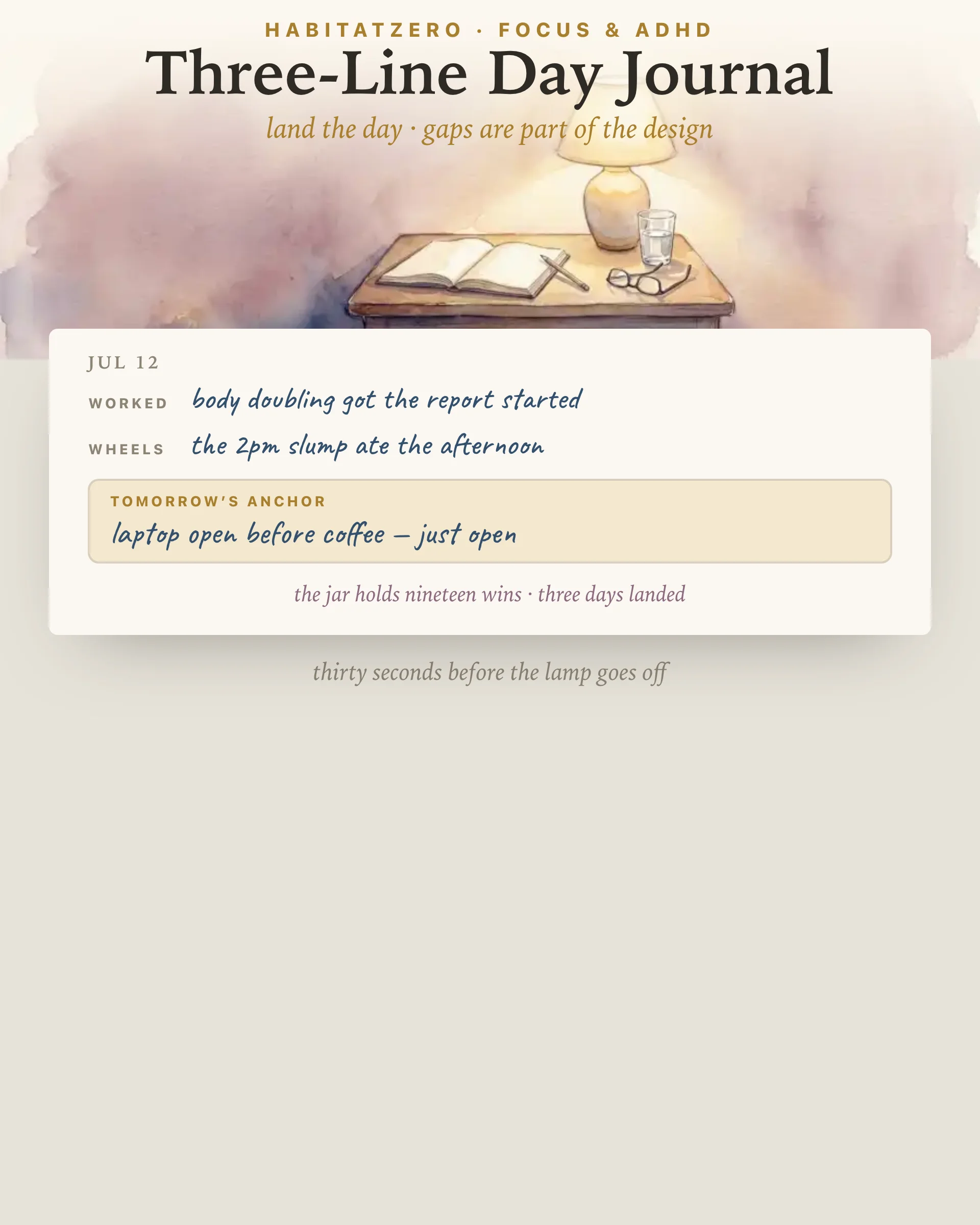
Every ADHD bookshelf has one: the beautiful journal, abandoned at page six. Not because journaling failed — because the journal was sized for a different brain. Open-ended pages are a starting-tax the executive function differences of ADHD pay double, and streak counters turn the inevitable missed Thursday into a reason never to return. This journal is built backwards from those two failure modes: three tiny lines, and no score to lose.
What worked today. Not what you finished — what worked: the body double that got the report moving, the timer trick, saying no. Naming the mechanism is how you get to reuse it, and an ADHD day contains more working mechanisms than an ADHD memory will admit.
Where the wheels came off. One honest clause, zero self-prosecution. The 2pm slump, the doomscroll, the meeting that ran through lunch. Patterns you can see are patterns you can plan around — this line is data collection, not confession.
Tomorrow's one anchor. The smallest concrete action that gives the morning a handle: laptop open before coffee. Just open. Deciding it tonight is a tiny implementation intention — the if-then form of planning with strong meta-analytic evidence for follow-through — and it pairs naturally with the anchored day planner, where a whole day hangs on anchors like this one.
Any single line counts as landing the day. Three is a good night, one is enough.
Above the prompts sits a button that asks for no writing at all: drop a win in the jar. Answered the email. Drank the water. Started. The tally climbs all day, and by evening the jar has quietly assembled the case that today held more wins than it felt like — the kind of visible, low-effort evidence that time-management guidance for ADHD adults leans on instead of willpower.
And deliberately, defiantly: no streak. Gaps are part of the design. Come back after a lost week and the page greets you with your old entries and an empty form — no zeroed counter, no guilt banner, no "you were doing so well." The journals that survive ADHD are the ones that forgive it.
This is the reflection tool in a family of doing tools. The anchored day planner shapes the day ahead; the room reset planner and the tiny-win cleaning checklist get rooms unstuck; this page is the ninety seconds at night that turns whatever happened into one reusable lesson and one handle for tomorrow.
Three lines. A jar of wins. A journal that keeps entries, not score.
Less than you think. Long reflective journaling is exactly the kind of open-ended task that executive function struggles to start, which is why most journals die by page six. This page asks for three specific lines — what worked, where the wheels came off, tomorrow's one anchor — and accepts any one of them as a complete entry.
Because streaks punish the brain this journal is for. Missing days is not a character flaw, it is a Tuesday — and a zeroed counter after a gap is the single most reliable way to turn one missed night into a permanently abandoned journal. Here, gaps carry no penalty and no banner; the page keeps entries, not score.
For the wins that are real but too small to journal about: starting the task at all, making the call, closing the laptop on time. One tap drops one in; the tally grows quietly at the top of the page. On a flat day, nineteen small wins in a jar is a better answer to how am I doing than memory will ever give you.
It is one item, chosen the night before, deliberately small and concrete — laptop open before coffee, shoes by the door. The anchor is not the day's plan; it is the handle the day starts by. If shaping the whole day is what you need, that is the anchored day planner's job, and this journal hands your anchor straight to it.
Three lines a night in the browser cost nothing. A HabitatZero account keeps your landed days and your jar count across visits, unlocks personalizing, and prints the journal if paper by the bed is where it belongs.
By the team behind Fabulous, the science-based self-care app used by over 30 million people.