ADHD Daily Task OrganizerFocus & ADHD · ~10 min
About this template · Updated September 2026
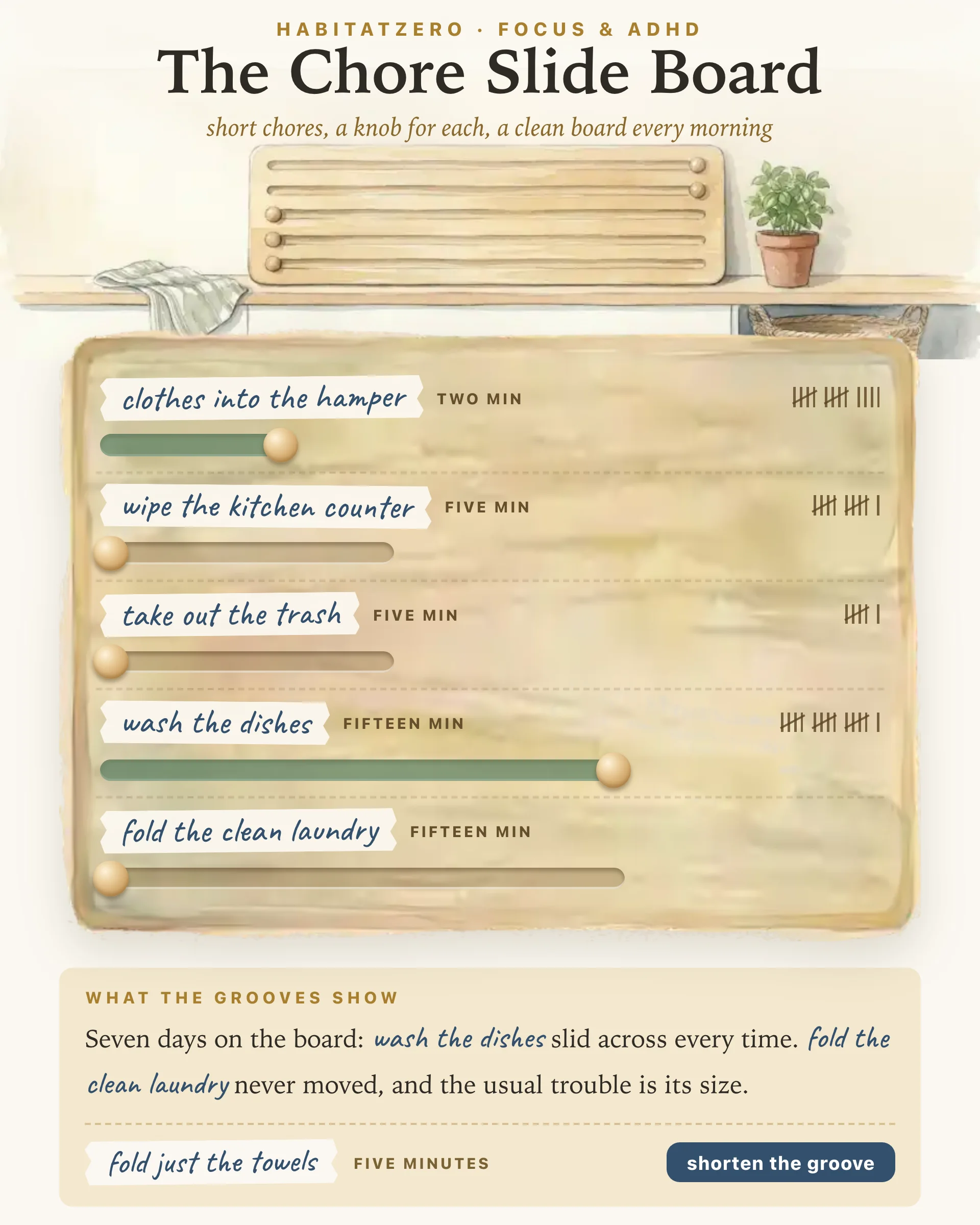
Most chore charts for adults with ADHD fail in their second week, and not because the chores got harder. They fail because the chart turns into a record of the days that didn't happen. By Friday there are three blank columns in a row, the chart reads like a report card, and it is easier to stop looking at it than to keep filling it in. This board is built around one rule: it shows what got done, and nothing about the days in between.
Every chore gets a groove, and each groove is as long as its chore takes. Two minutes is a short groove, fifteen is a long one, and the short ones sit at the top, so the easiest start is always the first thing you see. When a chore is done, tap its groove and the wooden knob slides across. If you tapped the wrong one, tap it again and the knob slides back.
The board holds six grooves. Ask for a seventh and it refuses until you take one off, because the aim is a board you can finish on an ordinary day, not an inventory of your home. It starts you with three small ones, clothes into the hamper, the kitchen counter and the dishes, and a row of suggestions underneath lets you swap them with a tap. Anything else can be written in a few words and given a size.
Every morning the knobs are back at the start. There is no overdue pile and no Monday to wait for. A day you never opened the board is simply not on it. What stays are the pencil tally marks beside each groove, one for every time that chore went across, and they only ever go up.
How a record displays your past can change whether you keep going, separately from what you actually did. Across seven studies, the consumer researchers Jackie Silverman and Alixandra Barasch found that people shown an unbroken streak in a log of their behavior kept that behavior up more than people shown a broken one, even when the real history behind the two logs was the same. The gap widened when people blamed the break on themselves, and it narrowed when they could repair the streak.
The feelings side points the same way. In a study of more than a hundred first-year university students, those who forgave themselves for putting off studying for a first midterm procrastinated less before the second one, and the link ran through fewer negative feelings. The Attention Deficit Disorder Association gives housework advice in the same spirit: its guide to a cleaning schedule you can keep suggests restarting right away instead of waiting for Monday. This board does that restart for you each morning.
Be clear about the limits. Neither study involved ADHD or chores: one looked at consumers and the streaks in their activity logs, the other at students and exams. Nothing here treats ADHD, and no study has tested a slide board. It is a design choice that leans on nearby evidence, and your own kitchen is where you find out whether it holds.
After three days of use, the note under the board starts reading your record. It says how many knobs usually go across on a day you use the board, names the chores that slid across every time, and picks out the one that has not moved at all.
That last one is usually a size problem, not a character problem. In a large meta-analysis of procrastination research, how unpleasant a task feels turned up as a strong and consistent predictor of putting it off, which is why the note blames the chore's size rather than you. It offers a smaller version with one tap: fold just the towels instead of the whole basket, put away just the glasses instead of emptying the dishwasher. A chore you wrote yourself shrinks to two minutes of it, and two minutes still counts. If even that doesn't move, take it off the board. That tells you something useful as well.
Give the grooves to the daily things that keep your place livable: dishes, trash, clothes off the floor, a clear counter. Weekly jobs like changing the sheets don't suit a board that starts clean every morning, and six grooves fill up fast.
If you share the housework with a partner or roommates, The Household Chore List splits the whole week between you and adds up everyone's minutes. If you are setting chores for a child, the Chore Chart puts their name on top with a week of stamps and a reward line. And when a whole room has gotten away from you, the Room Reset Planner breaks it into five-minute moves.
A handful of short daily chores that keep a home livable, each small enough to finish in one go: dishes, trash, clothes into the hamper, a wiped counter. This board takes six at most, and three you actually finish beat ten you keep walking past.
Usually because missed days pile up on the page. A grid of weekdays turns every skipped day into an empty box, and a chart full of empty boxes starts to feel like a verdict. This one resets each morning and records only finished chores, so coming back never means catching up.
Nothing piles up. When you open the board again, every knob is back at the start and the first line welcomes you back. The pencil tallies of everything you did before are still there, and the days in between are never counted against you.
It is written for adults running their own homes. If you are setting chores for a child, the Chore Chart on this site puts the child's name at the top, with a stamp for each day and a reward line for a full week.
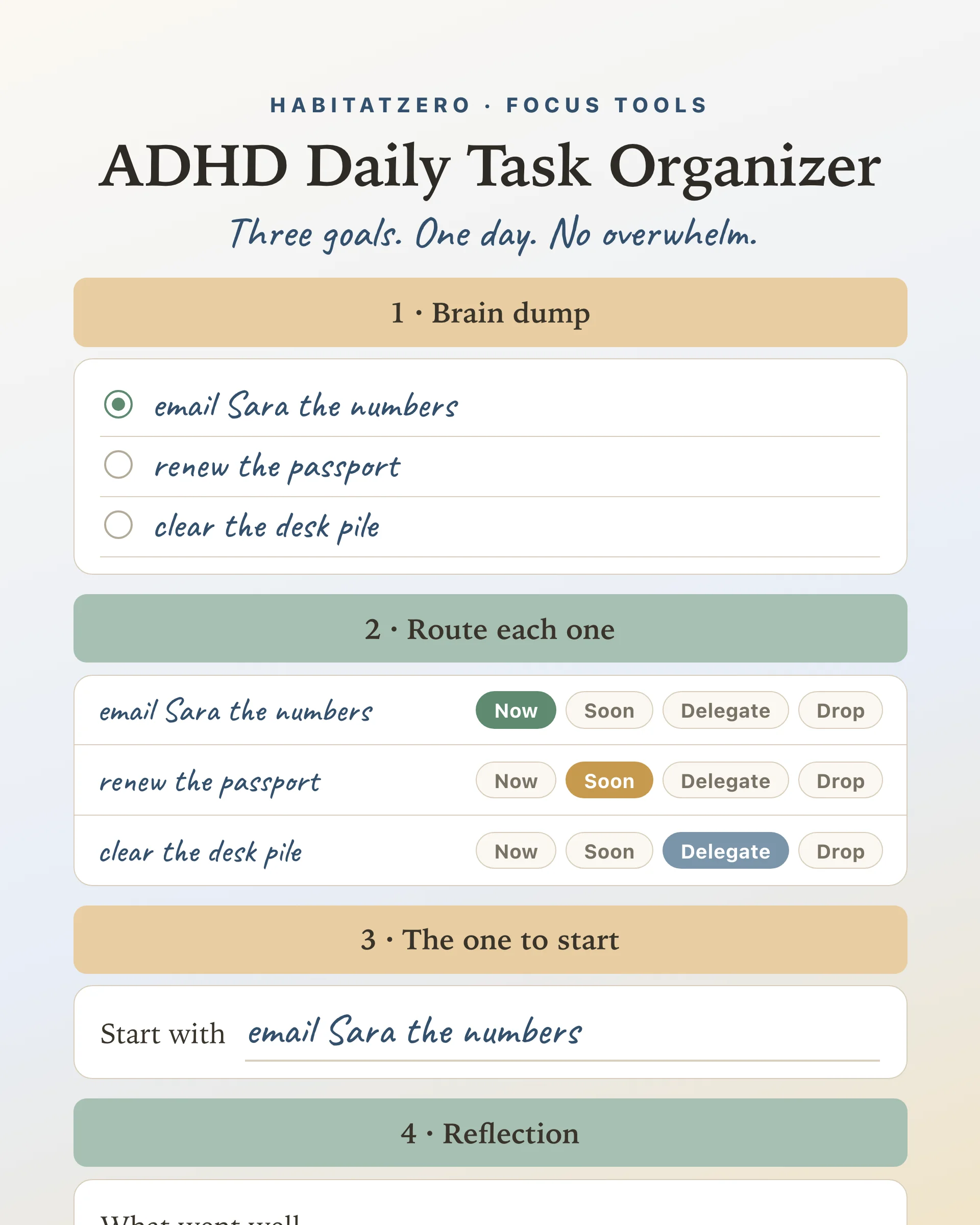
The page shows a filled-in board to look through. Carving your own grooves, sliding knobs from one day to the next and getting the note about stuck chores all happen once you personalize it in HabitatZero, which costs nothing.
By the team behind Fabulous, the science-based self-care app used by over 30 million people.