
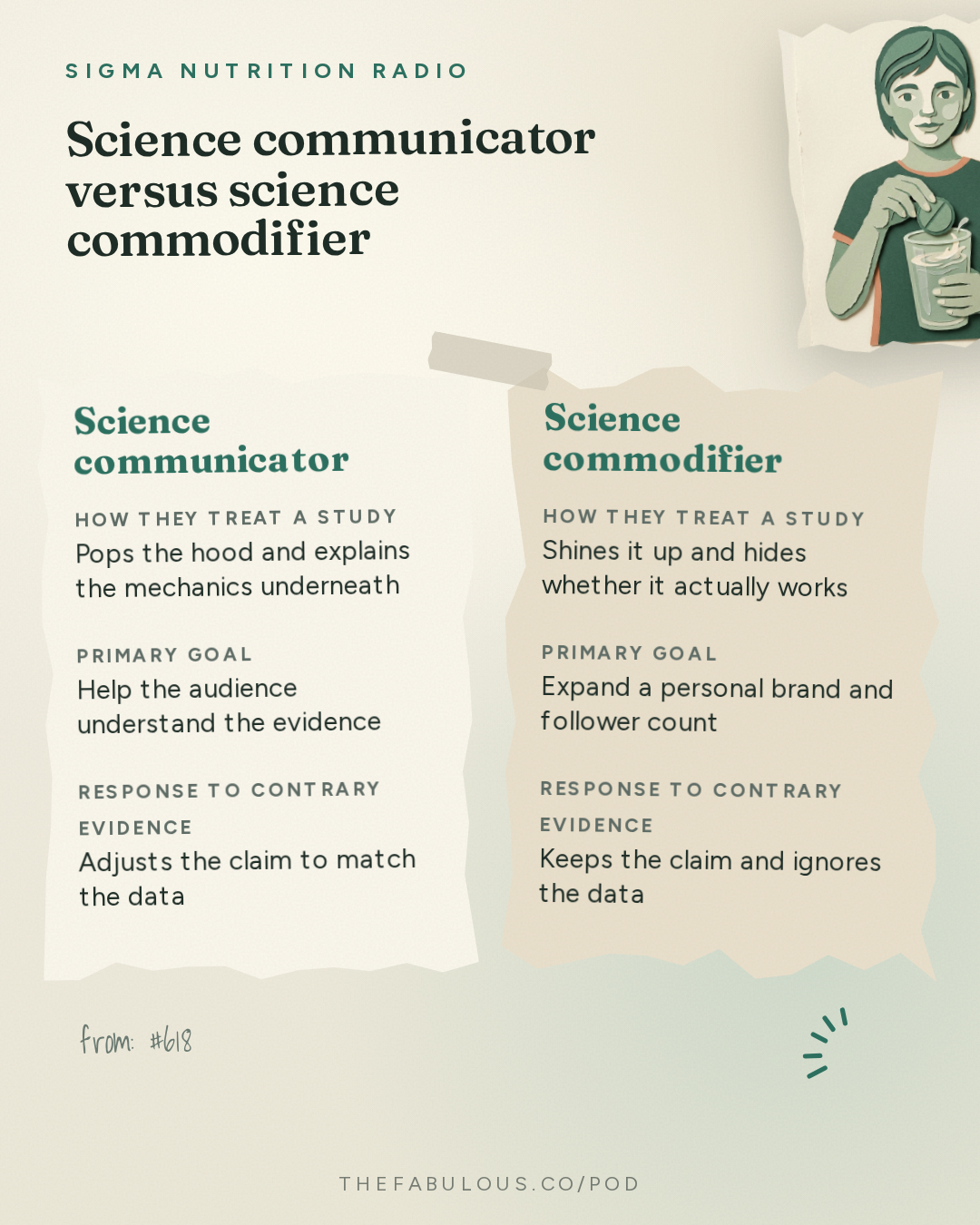
How Wellness Culture Commodifies Science
#618: How Wellness & Optimisation Culture Can Commodify Science – Nick Tiller, PhD
The brief
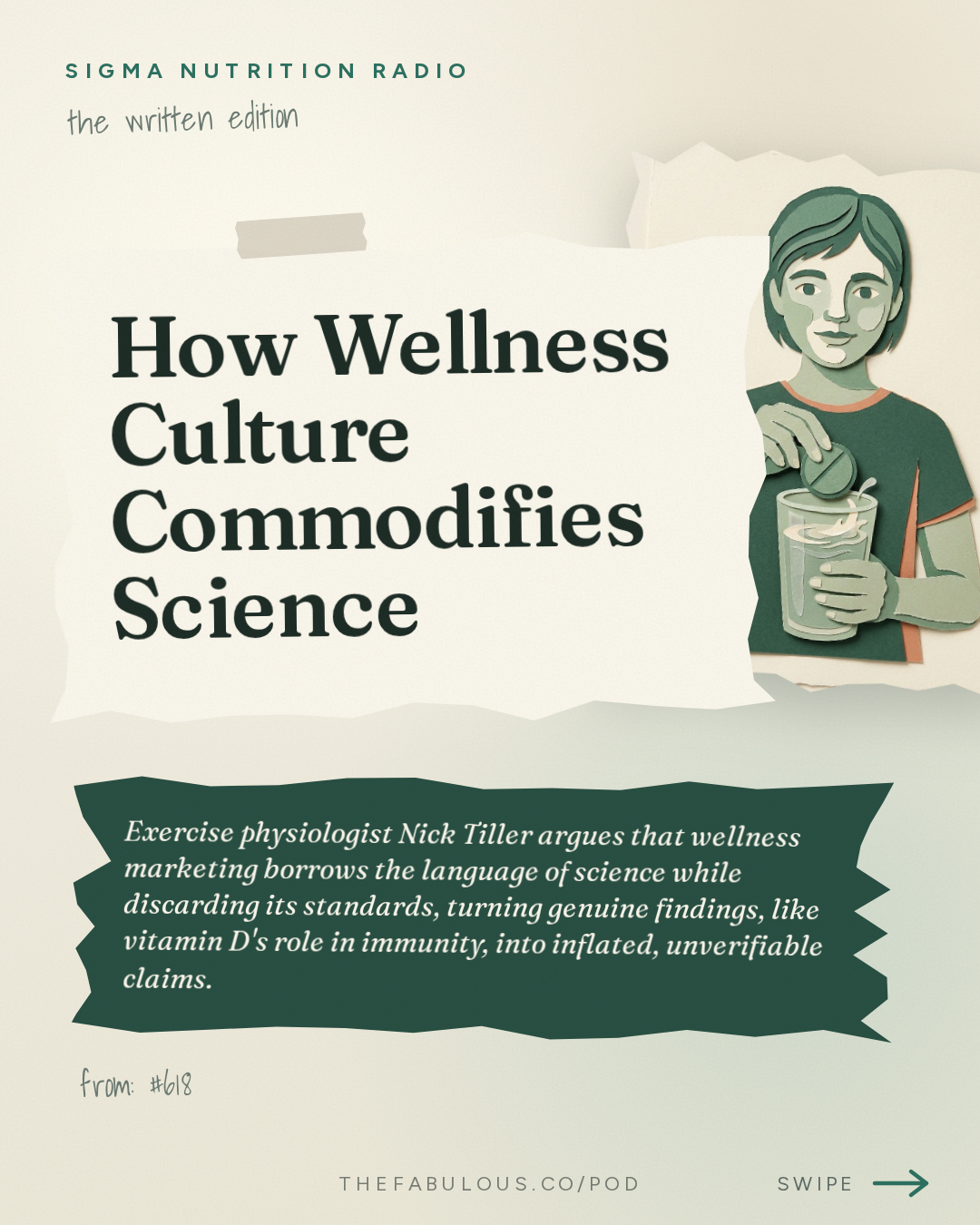
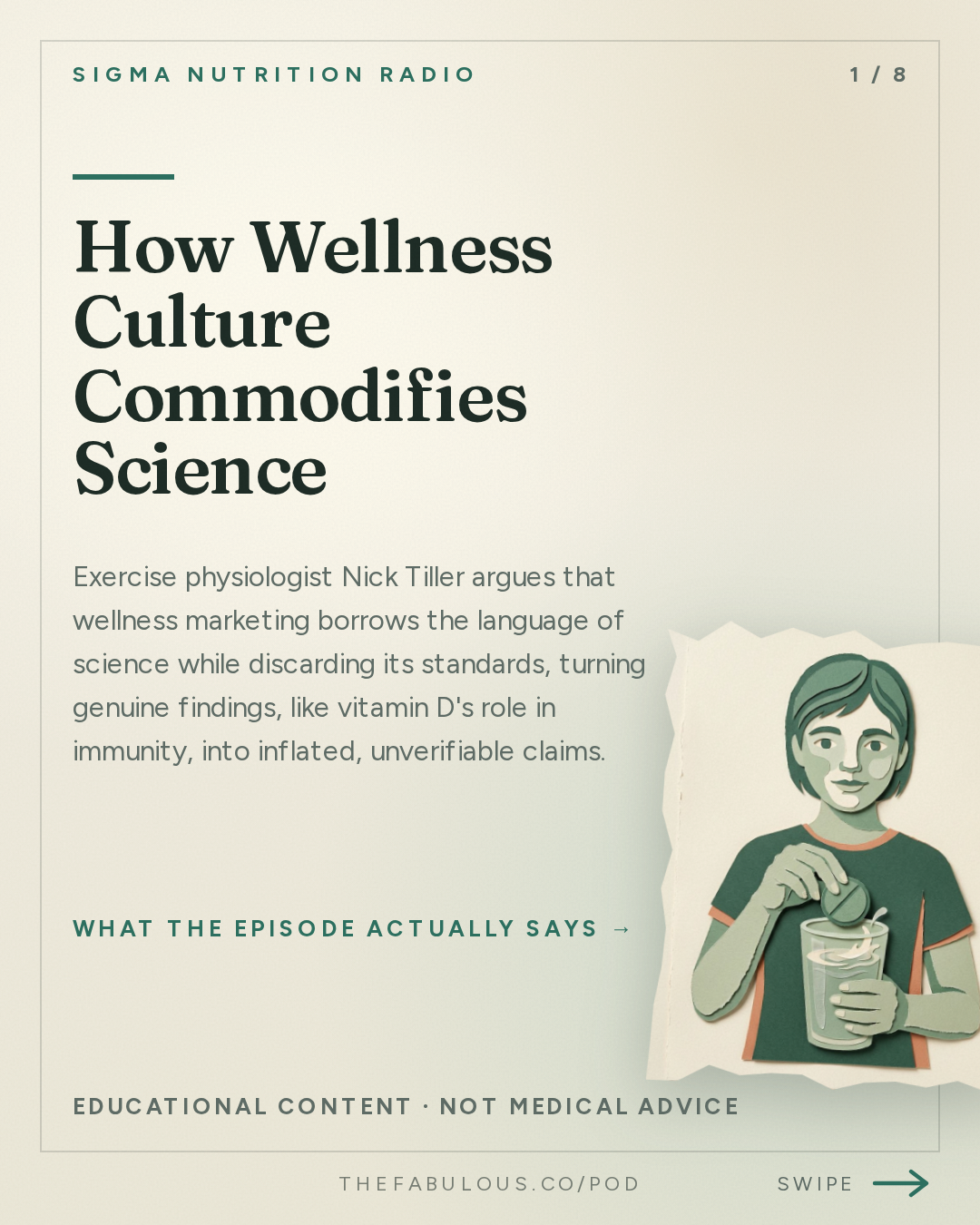
Exercise physiologist Nick Tiller argues that wellness marketing borrows the language of science while discarding its standards, turning genuine findings, like vitamin D's role in immunity, into inflated, unverifiable claims. He traces the damage upstream too: low statistical power, publication bias, and admitted data manipulation in exercise science feed the misinformation industry that influencers later sell.
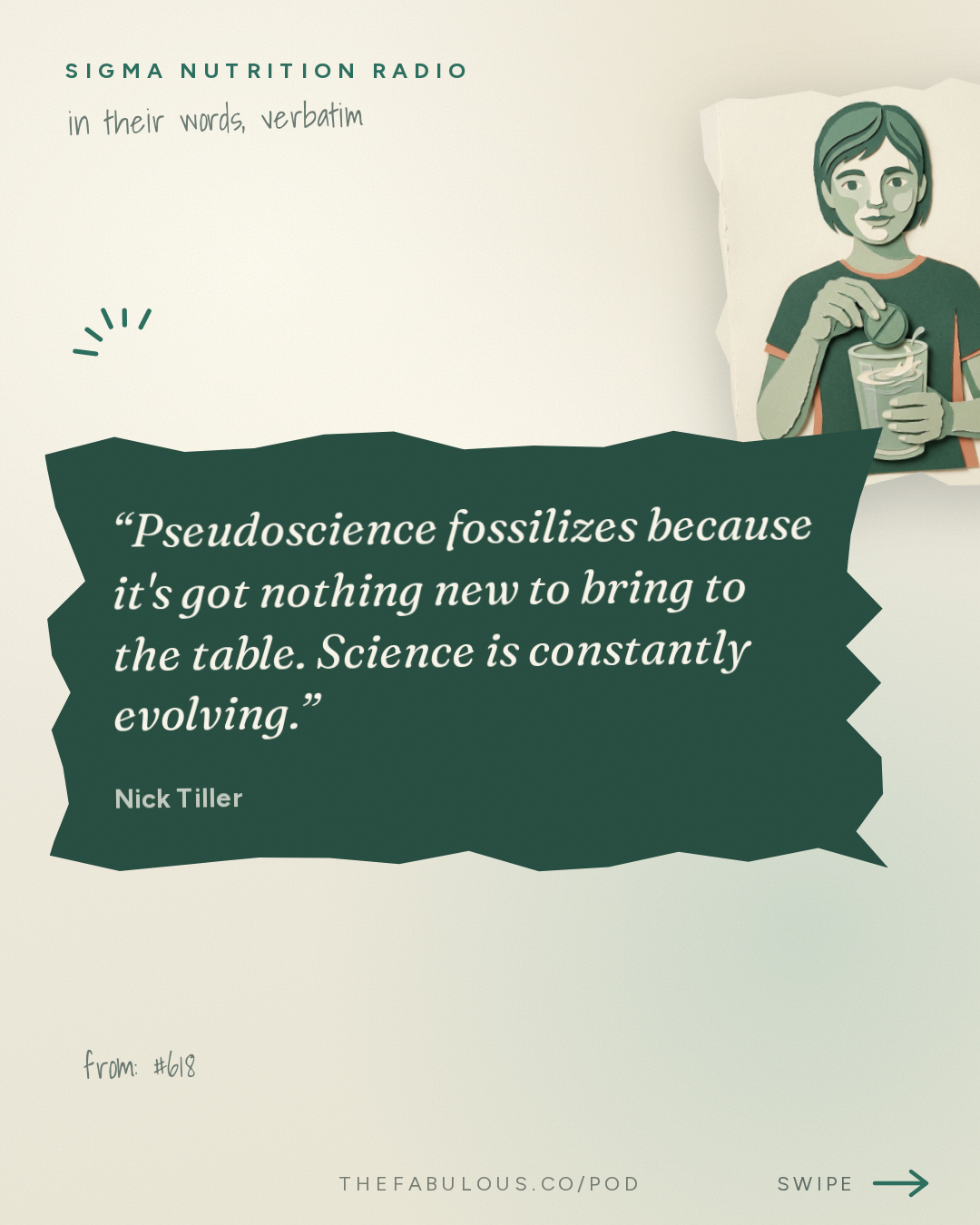
In the late nineteenth century, a traveling showman named Clark Stanley used to bring an old, stiff-jointed man up on stage, rub snake oil into his knees, and watch him bound around like a boy. The crowd gasped. They bought bottles. The trick worked because it felt personal: here was proof, right in front of them, that something worked. Exercise physiologist Nick Tiller, author of the book The Health and Wellness Lie, thinks the trick has never really changed. "The pattern of the con is unchanged for millennia," he says. "Pseudoscience fossilizes because it's got nothing new to bring to the table. Science is constantly evolving" (35:03). Only the stage has moved, from a wagon in the Old West to an Instagram feed.
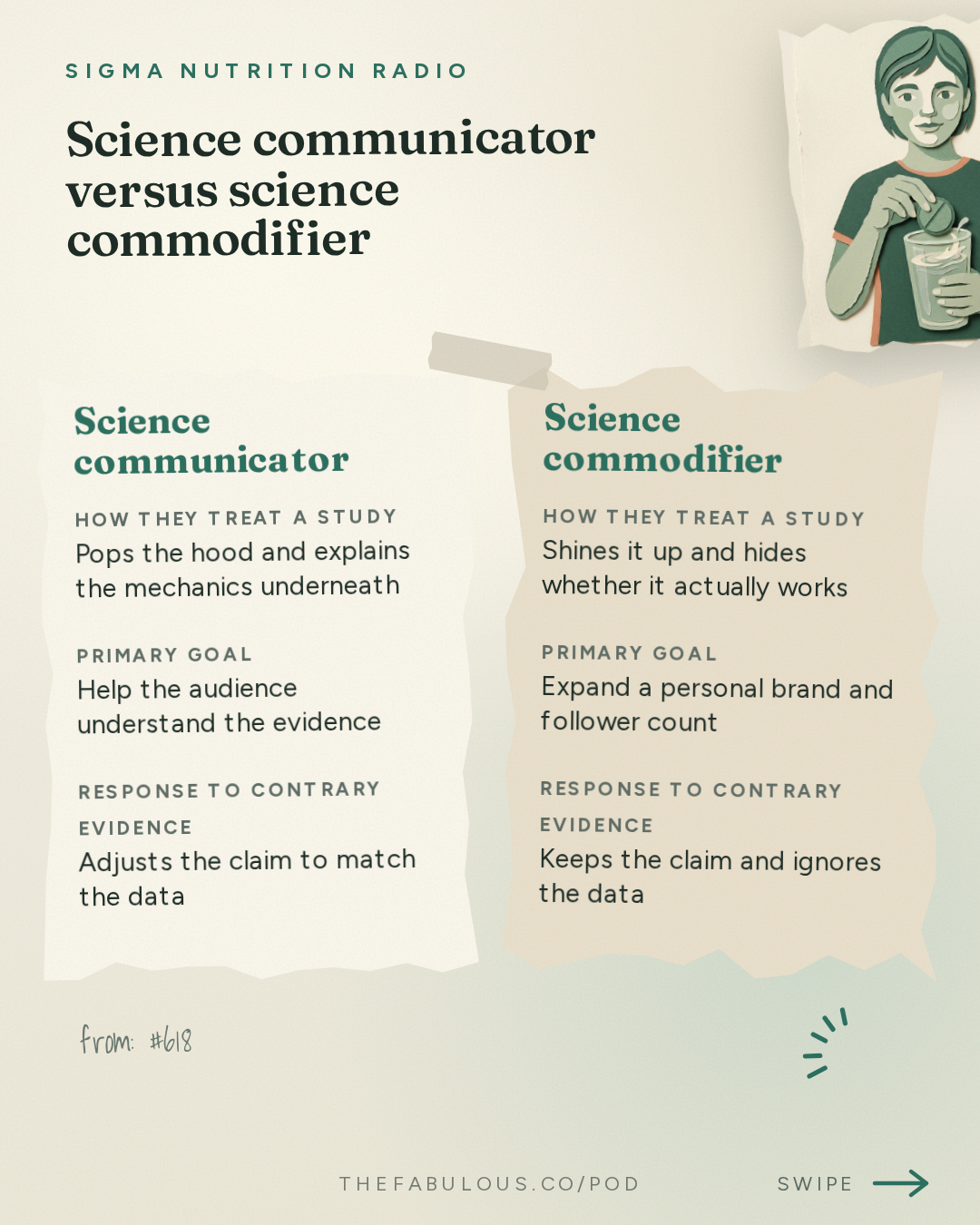
Tiller's case is not that health and wellness advice is uniformly false. It is that a highly profitable industry has learned to dress marketing in the clothing of science, and most people cannot tell the difference. "Everything that we know or think we know about health and wellness has been dictated to us by an industry... that puts profits above people," he says (06:53). He draws a distinction between two kinds of people who talk about science in public. A science communicator, he says, pops the hood and explains the mechanics underneath. A science commodifier is a car salesman:
"They'll just shine the thing up. They'll make it look really nice. They'll tell you how fast it goes, and they don't care if the thing breaks down a mile from the car lot." (Nick Tiller, [11:35])The commodifier isn't necessarily a fraud from the outside. Often he has real credentials. That is exactly what makes him hard to spot.
A Study, a Tweet, and Fifty Kilograms That Never Happened
Tiller's clearest example involves vitamin D, a nutrient with a real and boring truth behind it: deficiency is common, it is bad for long-term health, and a doctor can fix it with diet, a supplement, or in extreme cases an injection (14:41). None of that is controversial. The trouble starts when a nutrient with a real halo effect gets recruited into bigger claims. A study a few years back, run on 40 monozygotic twins split into a control group and a vitamin D group, reported that 60 days of a moderate-to-high dose supplement raised cardiorespiratory fitness, measured by VO2 max, by 27 percent (16:05). Rhonda Patrick, a health information personality with 1.5 million Instagram followers at the time, tweeted the finding, and it spread within hours (18:27).
Tiller says it took him about ten seconds looking at the results table to know something was wrong. The study reported a 27 percent jump in absolute VO2 max, liters of oxygen per minute, but no change at all in relative VO2 max, which is the same measurement divided by body weight. The only way both numbers can be true at once is if the subjects gained an enormous amount of weight during the trial, something like 50 kilograms in 60 days (18:03), which is not physiologically possible. Tiller wrote to the journal. The authors could not produce their raw data. The paper was retracted, but only after racking up a large "Altmetric" score, a measure of how much online attention a paper gets, and after Patrick's post had already been liked and shared thousands of times (18:27). "With great power comes great responsibility," Tiller says. "Did she not read the study before sharing it? Or did she read it and not see the glaring errors?" (18:49).
The lesson he draws isn't just about one tweet. It's about a mismatch in incentives. "Social media algorithms work in an opposite way to how science works," he says (23:23). Science moves slowly and rewards caution; a single study is never supposed to settle anything. Social platforms reward the opposite: confidence, sensational claims, and anything that produces a strong emotional reaction.
This is where Tiller wants listeners to draw a line between skepticism and cynicism, terms people often use as synonyms but that mean very different things. Scientific skepticism, a phrase coined by astronomer Carl Sagan in the 1970s, means applying the same demanding standard of evidence to every claim rather than dismissing anything unfamiliar out of hand. A cynic just says no. A skeptic asks for data, looks at whether the claim is even physically plausible, such as clip-on earrings marketed to "shrink fat cells" with infrared light, and then decides.
"A cynic just dismisses things out of hand... A skeptic keeps an open mind, but not so open that their brains fall out." (Nick Tiller, [28:30])The line, borrowed from physicist Richard Feynman, matters because it protects the skeptic from becoming exactly what he is trying to correct: someone who reacts on instinct rather than evidence.
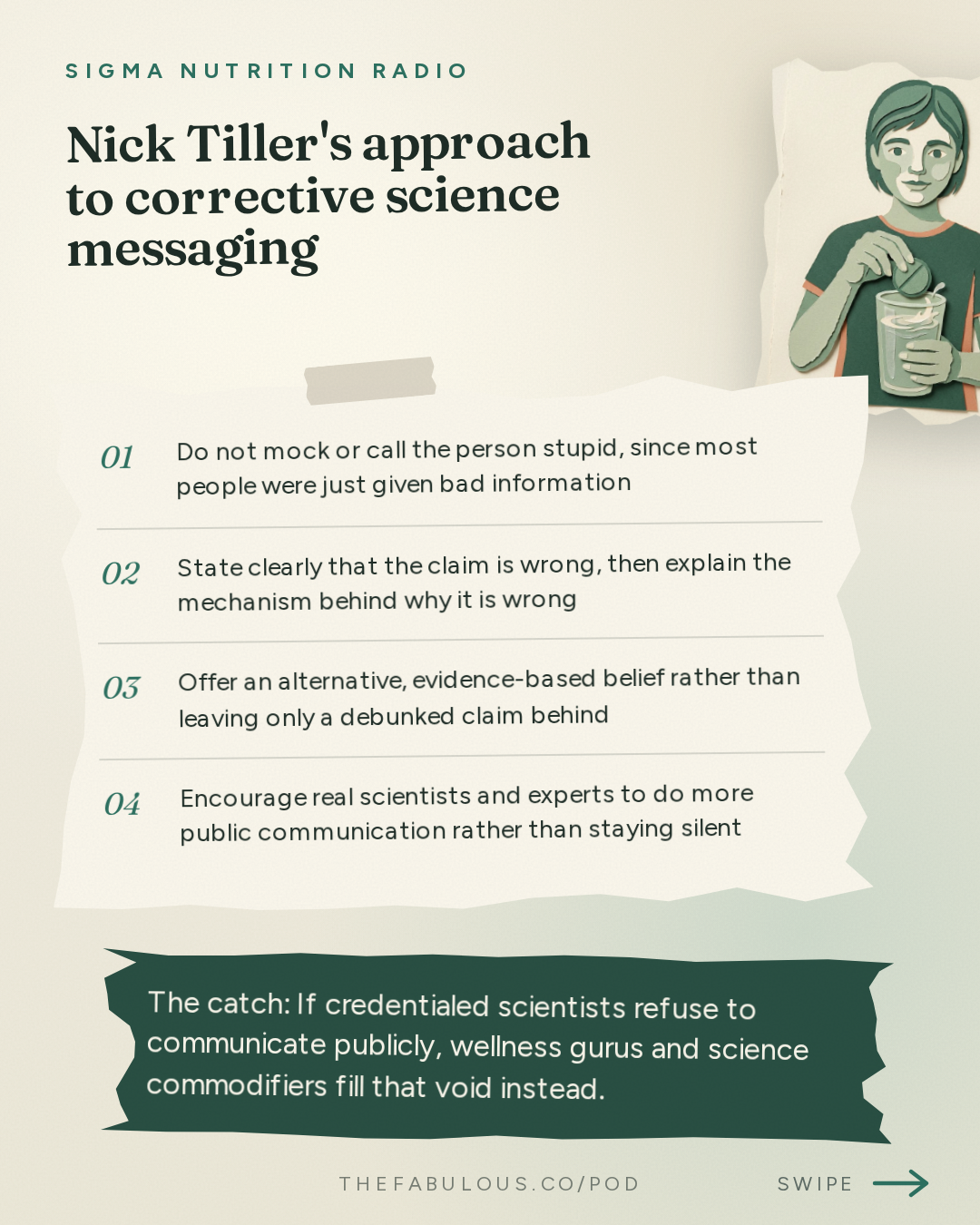
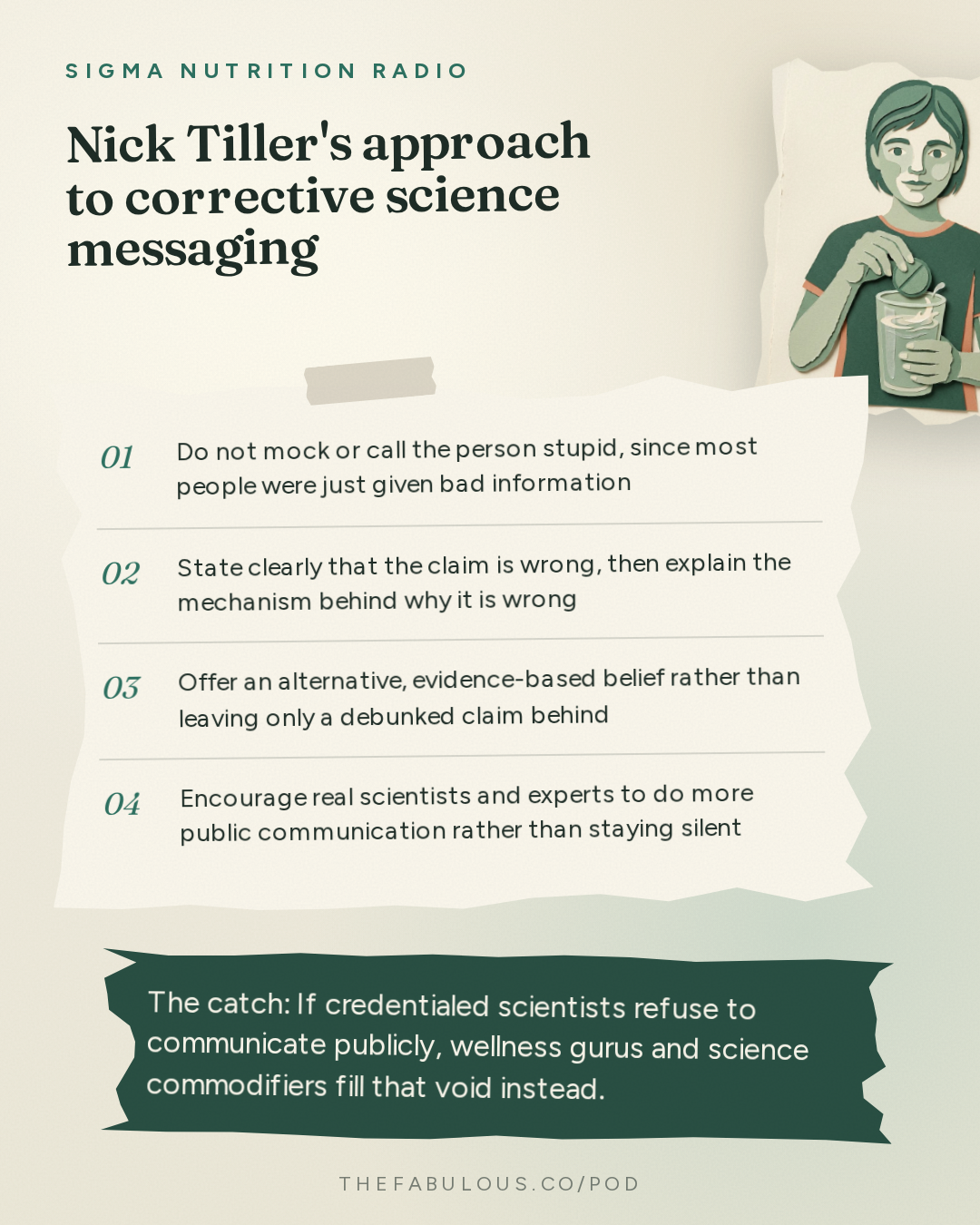
When it comes to actually correcting someone who has fallen for bad information, Tiller's advice runs against the instinct to mock. People spreading wellness nonsense are usually not stupid, he says; they were given bad information, and everyone is vulnerable to that (30:15). Effective correction, in his view, explains the mechanism of why a claim is wrong and offers something to believe instead, rather than just tearing down the false claim and leaving a void (31:18). He also blames a quieter problem: legitimate scientists often avoid talking to the public because doing so can hurt their academic reputation, a phenomenon named after Sagan himself. "There is this stigma that somebody who communicates with the public is somehow a worse scientist," Tiller says (32:43), even though the two skills have nothing to do with each other. He quotes science educator Shirley Malcolm on what happens when scientists stay quiet:
"If you don't tell your own story, someone else will tell it for you, and you may not like how they do it." (Nick Tiller quoting Shirley Malcolm, [33:03])
The Problem Starts Before the Marketing Does
The second half of Tiller's argument is less about influencers and more about the research they cite. Bad science, he says, is rarely the product of villains fabricating results, though some do. More often it comes from ordinary researchers misunderstanding their own tools. Statistical power is the odds that a study will detect a real effect if one actually exists; researchers generally aim for a power of at least 0.8, meaning an 80 percent chance of catching a true effect (44:04). A meta-analysis of more than 40 studies on high-intensity interval training found an average power of just 0.14, a 14 percent chance (43:13). Small samples studying small effects produce results too noisy to trust, no matter what the abstract claims.
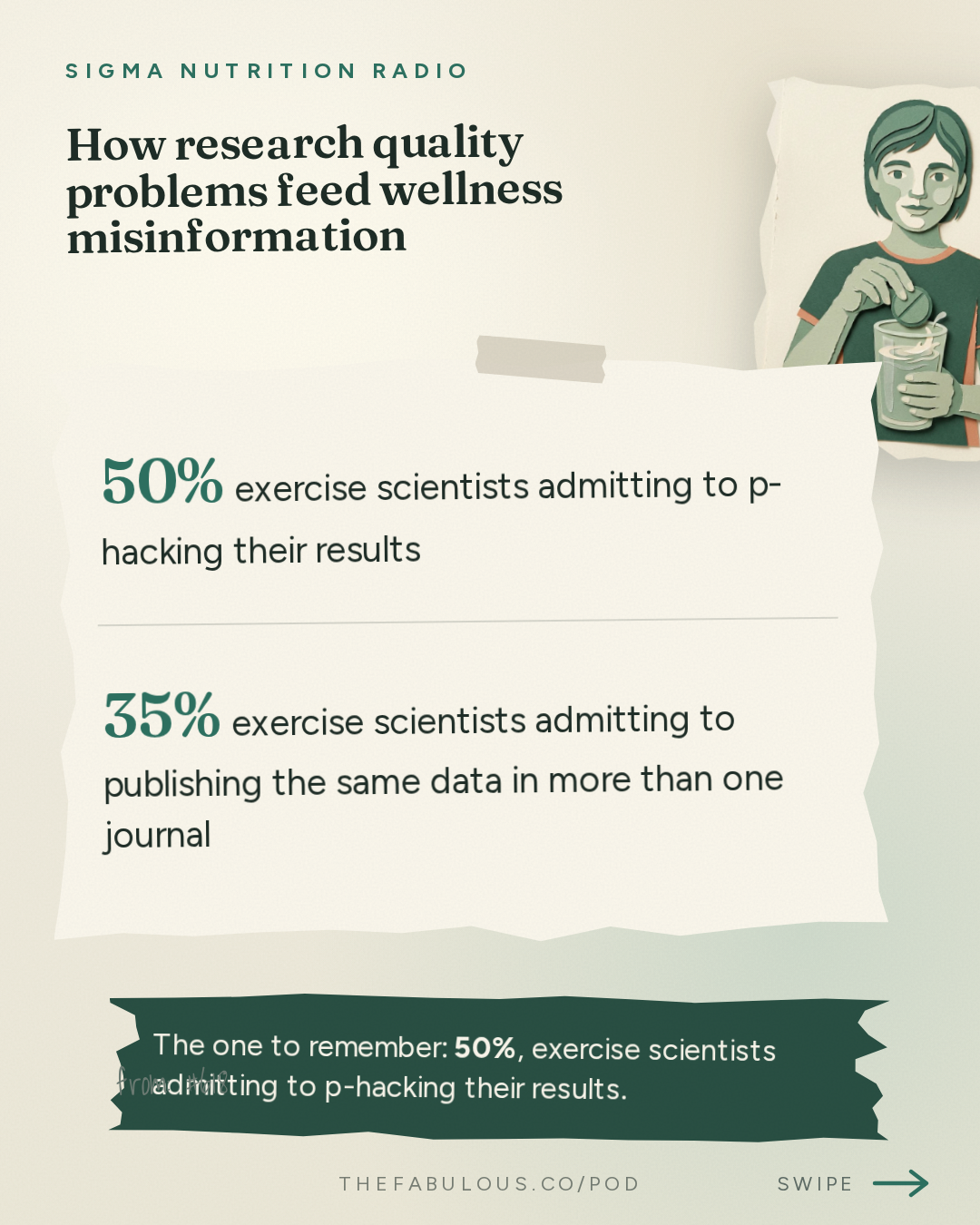
Funding compounds the problem. Studies backed by industry money are six times more likely to report positive findings than independently funded ones (44:27). And an unpublished survey of exercise scientists in the UK and US, still under peer review at the time of this conversation, found that 4.2 percent of respondents admitted to falsifying or fabricating data outright (48:20), 50 percent admitted to "p-hacking": running multiple statistical tests and reporting only the one that gives a favorable result (48:43), and 35 percent admitted to publishing the same data in more than one journal (49:09). Tiller thinks these self-reported numbers are almost certainly undercounts. He connects the pattern to academic publishing's "publish or perish" culture, where journals prefer positive, exciting findings and researchers are pressured to produce them. "It's a garbage in, garbage out scenario," he says. "So the responsibility is with us to make sure that we are publishing good data" (47:58).
Tiller's closing advice has nothing to do with supplements or biohacks. Asked for one daily habit worth adopting, he picked reading, not to sell his own book, he insists, but because sustained attention has become rare. "Having the ability to actually dedicate your attention to something in this day and age is like a superpower, and it's increasingly rare," he says (54:03). Thirty minutes a day, phone off, spent on a book, a puzzle, or an instrument, is less a wellness trend than a quiet rebellion against an economy built to fracture attention in the first place. It is also, in its own small way, the same skill the rest of the conversation demands: the patience to look closely before deciding what to believe.
Ask this episode anything
Pod's AI answers from the episode itself, with the minute mark so you can hear it yourself.
Or start with one of these
Ask this episode
Pod's AI listens to the whole episode to answer, and points you to the minute it comes from.
The rest of this answer, and any question after it
Answers come from the episode itself, never from a summary of it.
ContinueKey takeaways
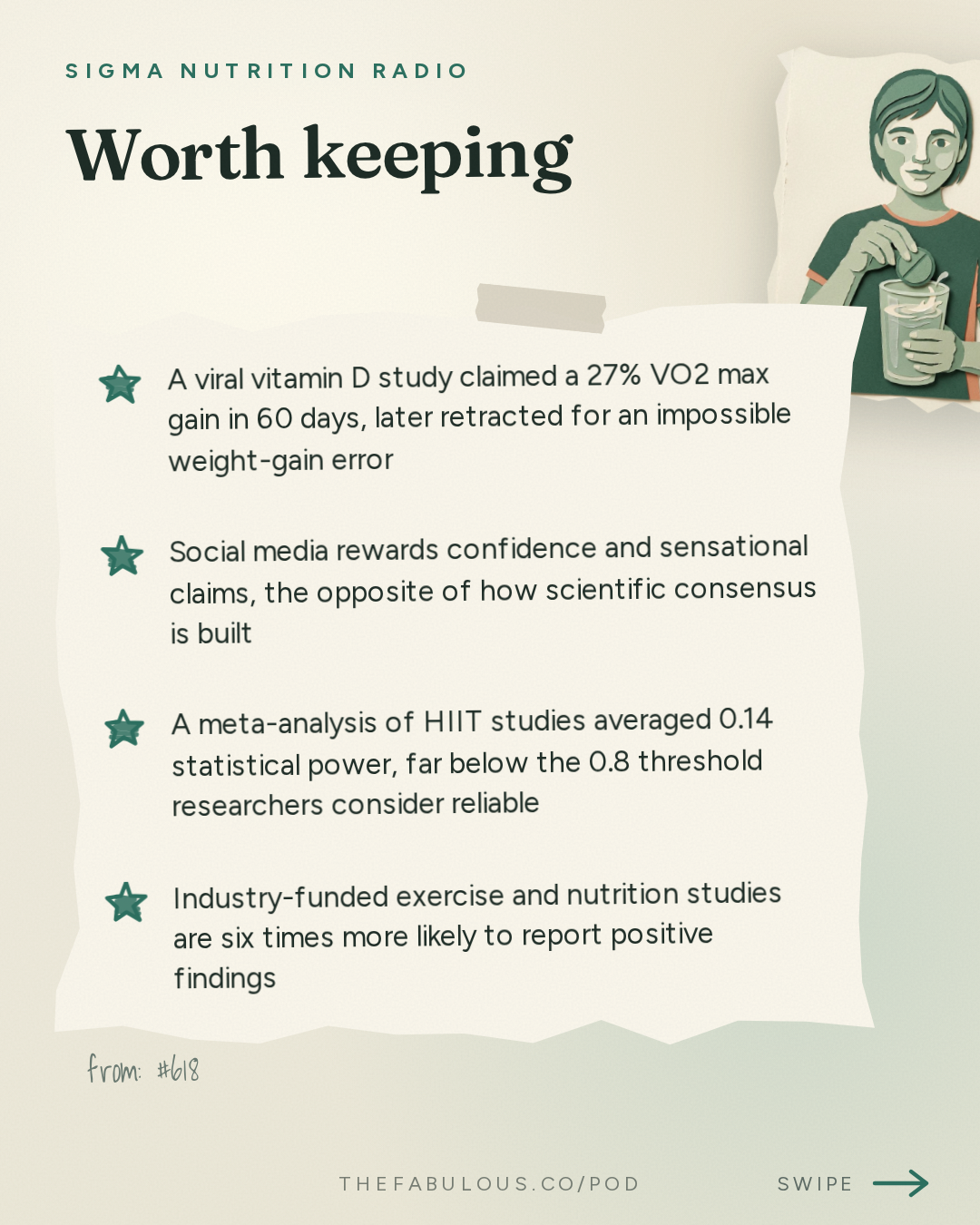
- A viral vitamin D study claimed a 27% VO2 max gain in 60 days, later retracted for an impossible weight-gain error
- Social media rewards confidence and sensational claims, the opposite of how scientific consensus is built
- A meta-analysis of HIIT studies averaged 0.14 statistical power, far below the 0.8 threshold researchers consider reliable
- Industry-funded exercise and nutrition studies are six times more likely to report positive findings
- A survey of exercise scientists found 4.2% admitted fabricating data and 50% admitted to p-hacking their results
The episode in cards
By the numbers
- 27% percent cardiorespiratory fitness increase claimed in a retracted 60-day vitamin D study
- 50% percent surveyed exercise scientists who admitted to p-hacking their results
In their words
“Everything that we know or think we know about health and wellness has been dictated to us by an industry, a highly profitable industry, that puts”
“Pseudoscience fossilizes because it's got nothing new to bring to the table. Science is constantly evolving.”
“It's basically a garbage in, garbage out scenario. So the responsibility is with us to make sure that we are publishing good data”
Protocols
-
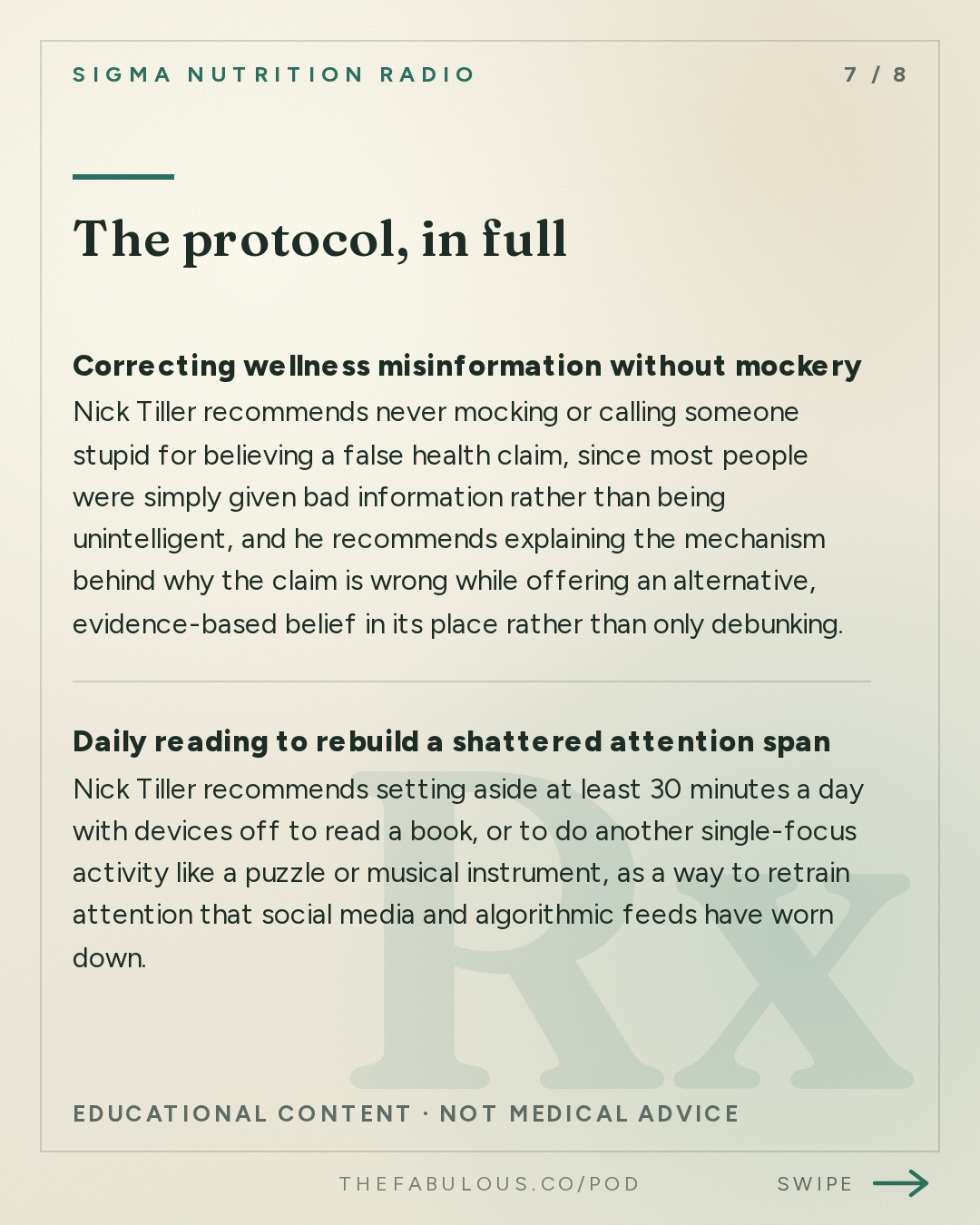
Correcting wellness misinformation without mockery
Nick Tiller recommends never mocking or calling someone stupid for believing a false health claim, since most people were simply given bad information rather than being unintelligent, and he recommends explaining the mechanism behind why the claim is wrong while offering an alternative, evidence-based belief in its place rather than only debunking.
whenever engaging with someone who shares a false health claim
-
Daily reading to rebuild a shattered attention span
Nick Tiller recommends setting aside at least 30 minutes a day with devices off to read a book, or to do another single-focus activity like a puzzle or musical instrument, as a way to retrain attention that social media and algorithmic feeds have worn down.
daily
Questions this episode answers
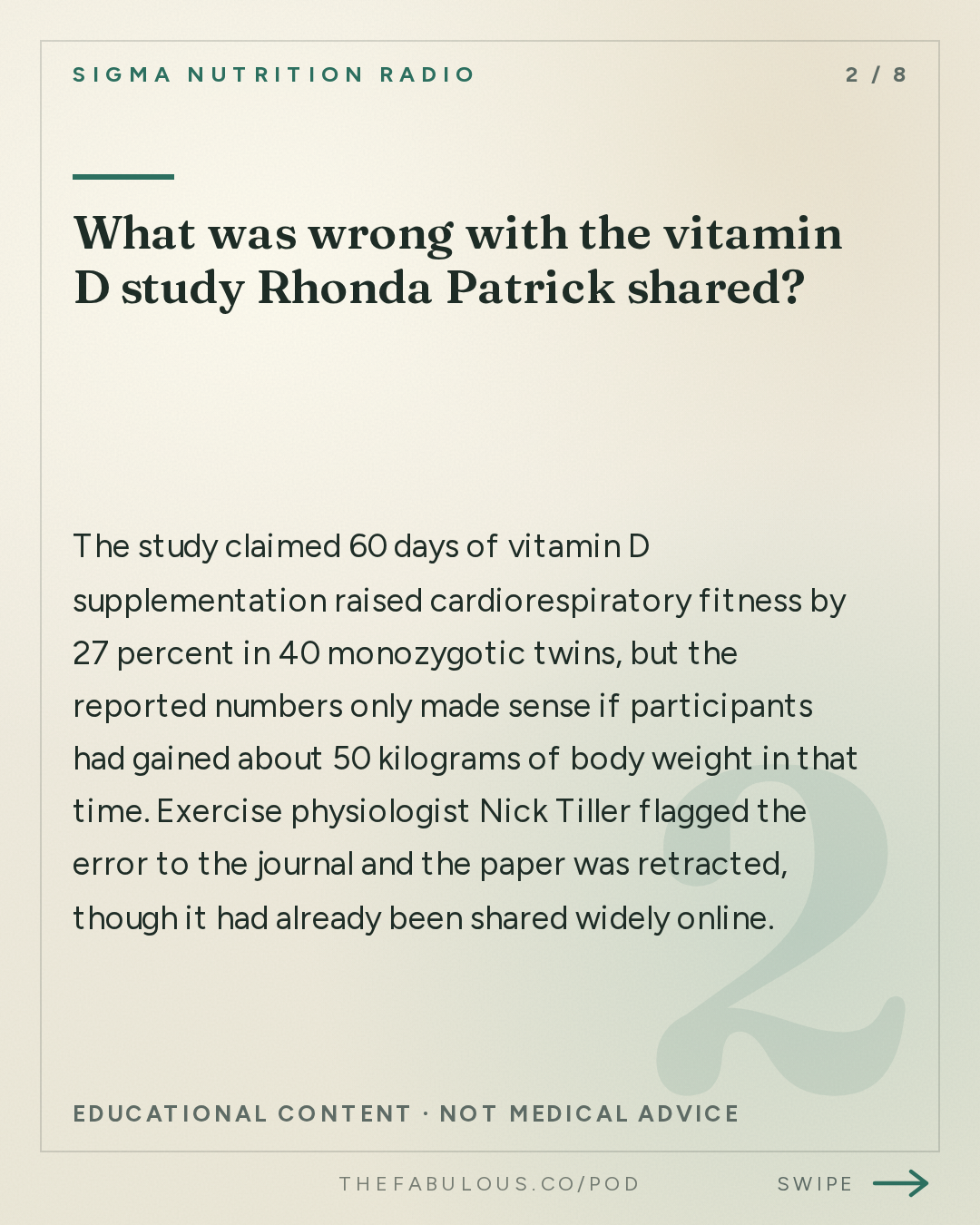
What was wrong with the vitamin D study Rhonda Patrick shared?
The study claimed 60 days of vitamin D supplementation raised cardiorespiratory fitness by 27 percent in 40 monozygotic twins (16:05), but the reported numbers only made sense if participants had gained about 50 kilograms of body weight in that time (18:03). Exercise physiologist Nick Tiller flagged the error to the journal and the paper was retracted, though it had already been shared widely online (18:27).
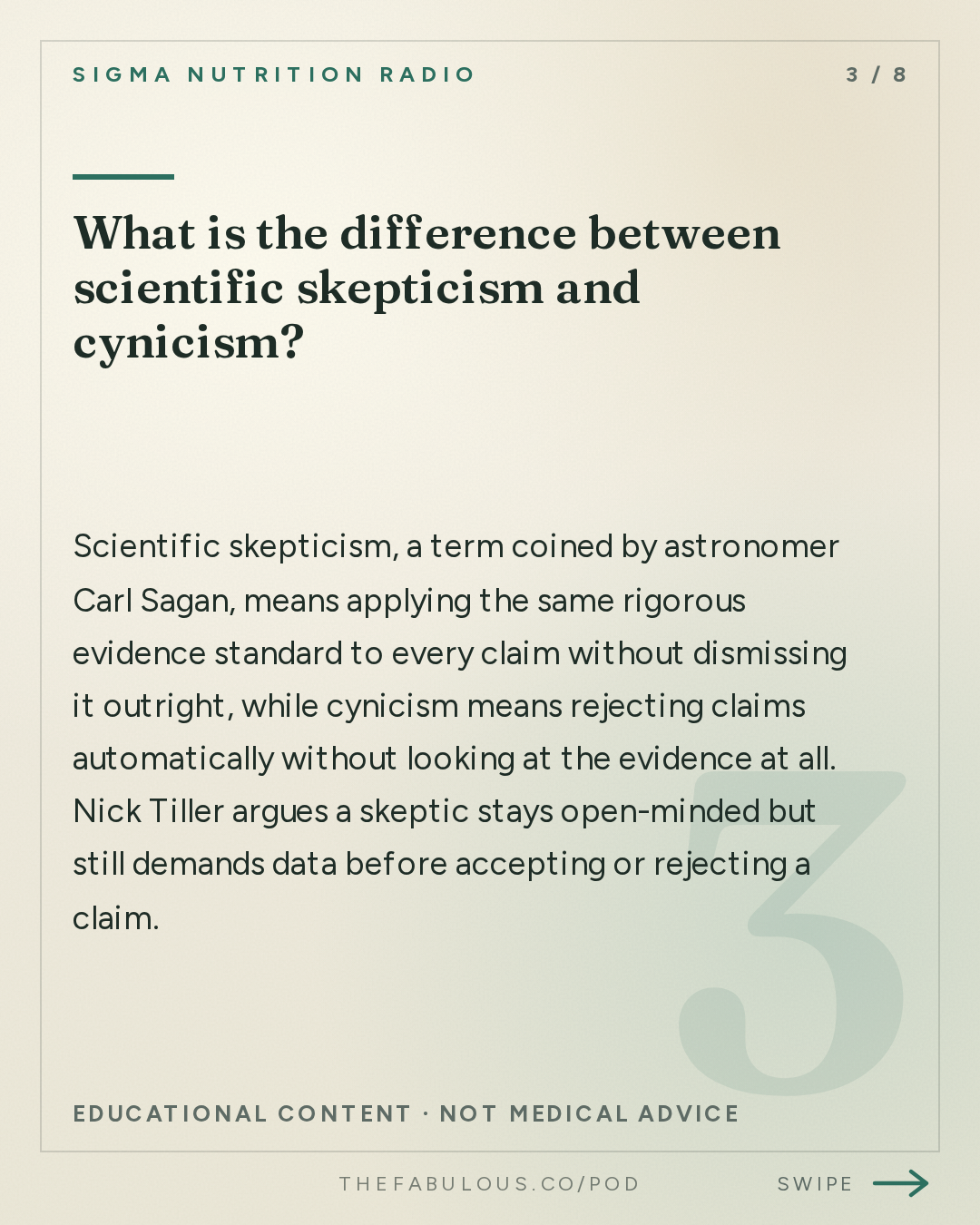
What is the difference between scientific skepticism and cynicism?
Scientific skepticism, a term coined by astronomer Carl Sagan, means applying the same rigorous evidence standard to every claim without dismissing it outright, while cynicism means rejecting claims automatically without looking at the evidence at all (26:01). Nick Tiller argues a skeptic stays open-minded but still demands data before accepting or rejecting a claim (28:30).
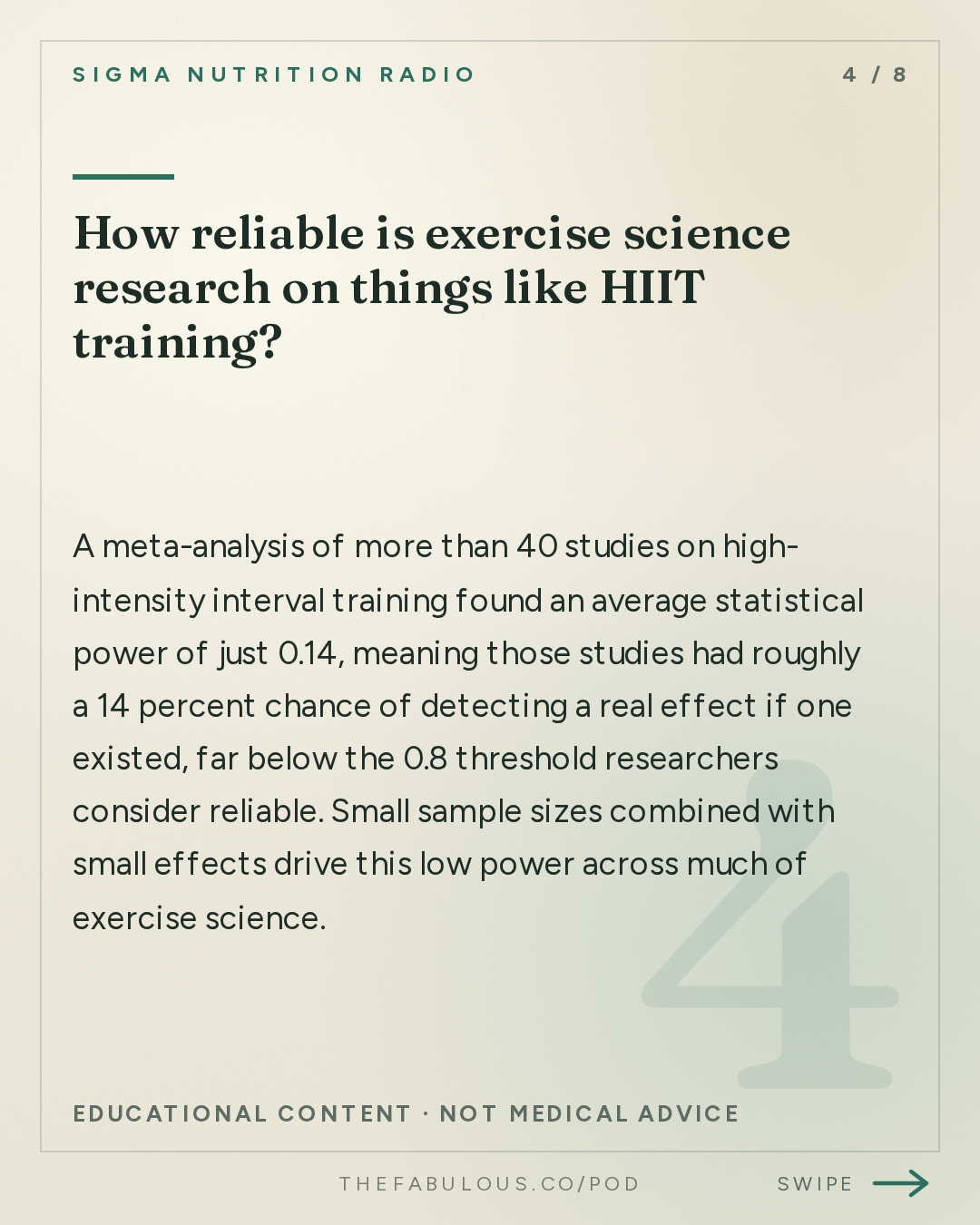
How reliable is exercise science research on things like HIIT training?
A meta-analysis of more than 40 studies on high-intensity interval training found an average statistical power of just 0.14, meaning those studies had roughly a 14 percent chance of detecting a real effect if one existed, far below the 0.8 threshold researchers consider reliable (43:13, 44:04). Small sample sizes combined with small effects drive this low power across much of exercise science.
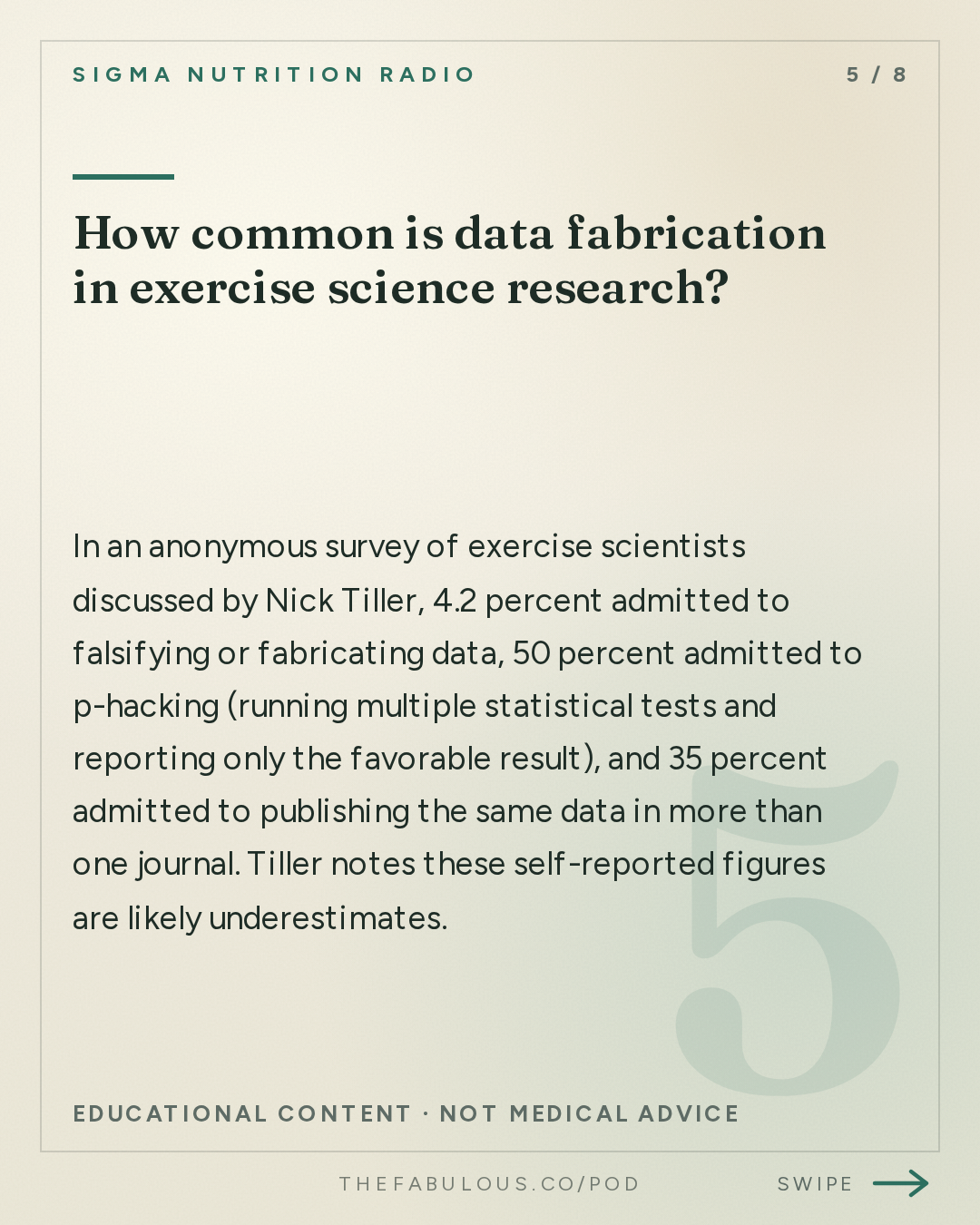
How common is data fabrication in exercise science research?
In an anonymous survey of exercise scientists discussed by Nick Tiller, 4.2 percent admitted to falsifying or fabricating data, 50 percent admitted to p-hacking (running multiple statistical tests and reporting only the favorable result), and 35 percent admitted to publishing the same data in more than one journal (48:20, 48:43, 49:09). Tiller notes these self-reported figures are likely underestimates.
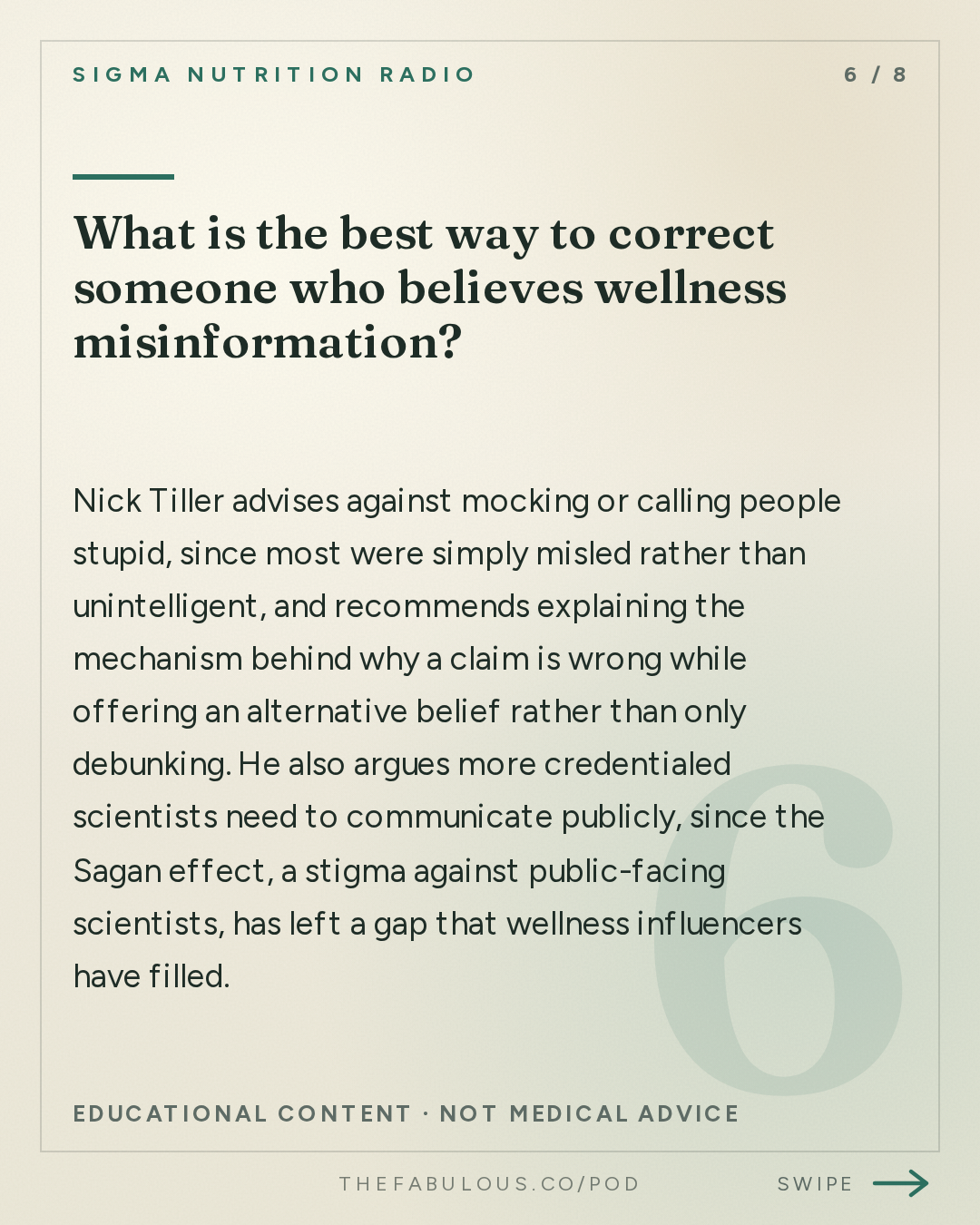
What is the best way to correct someone who believes wellness misinformation?
Nick Tiller advises against mocking or calling people stupid, since most were simply misled rather than unintelligent, and recommends explaining the mechanism behind why a claim is wrong while offering an alternative belief rather than only debunking (29:53, 31:18). He also argues more credentialed scientists need to communicate publicly, since the Sagan effect, a stigma against public-facing scientists, has left a gap that wellness influencers have filled (32:43).
Why do industry-funded supplement studies report more positive results?
Nick Tiller cites data showing studies financially supported by industry are six times more likely to report positive findings than independently funded studies (44:27), reflecting broader publication bias where journals favor exciting, positive results over null findings (45:39).
The full read, in cards
Go deeper
- How Skepticism, Not Cynicism, Can Raise Scientific Standards and Reform the Health and Wellness Industry — editorial published in the International Journal of Sports Nutrition and Exercise Metabolism in 2023 distinguishing scientific skepticism from cynicism
- Vitamin D and cardiorespiratory fitness twin study — claimed a 27 percent VO2 max increase from 60 days of supplementation, later retracted after an impossible weight-gain error was found
- HIIT training meta-analysis — covered more than 40 studies and found an average statistical power of 0.14, far below the recommended 0.8 threshold
- Anonymous survey of exercise scientists on questionable research practices — found 4.2 percent admitted fabricating data, 50 percent admitted p-hacking, and 35 percent admitted duplicate publication, still under peer review at time of recording
Mentioned
Nick Tiller · The Health and Wellness Lie · Rhonda Patrick · Carl Sagan · Richard Feynman · Clark Stanley · Shirley Malcolm · Skeptical Inquirer · International Journal of Sports Nutrition and Exercise Metabolism
More from this show and category
How to Interpret Testosterone Test Results
A single testosterone number rarely settles the question of whether treatment will help. Physician Austin Baraki says free testosterone, symptom type, and the underlying cause of a low reading (often obesity, poor sleep, or alcohol) matter more than one blood draw, and a 4 to 6 month trial beats a lifelong commitment.
Body Composition Testing: DEXA vs BIA Accuracy
No device on the market actually measures body fat; every scale, scan, or pod only estimates it from indirect signals, and a method proven accurate for a group can still mislead an individual user. Texas Tech professor Grant Tinsley explains why standardizing tests, tracking one device over time, and treating small percentage swings as noise matter more than any single number (12:49, 38:24).
Liking vs Wanting in Food Reward Psychology
Food reward splits into two separate systems: liking, the pleasure a food delivers, and wanting, the pull to eat it, which often runs on autopilot. Nutrition composition alone explains only 20% of why a food is liked (21:59); adding sensory perception explains another 40-60% (22:35), while ultra-processed classification barely moves the needle.
BPC-157 Safety and Clinical Evidence Explained
BPC-157 and similar peptide medications have almost no published human safety data, and most are sold as unregulated 'research chemicals.' Dr. Jordan Feigenbaum, founder of Barbell Medicine, explains the evidence gap, sourcing risks between research-grade chemicals and compounding pharmacies, and why pharmaceutical companies abandoned these compounds despite viral anecdotal enthusiasm.
