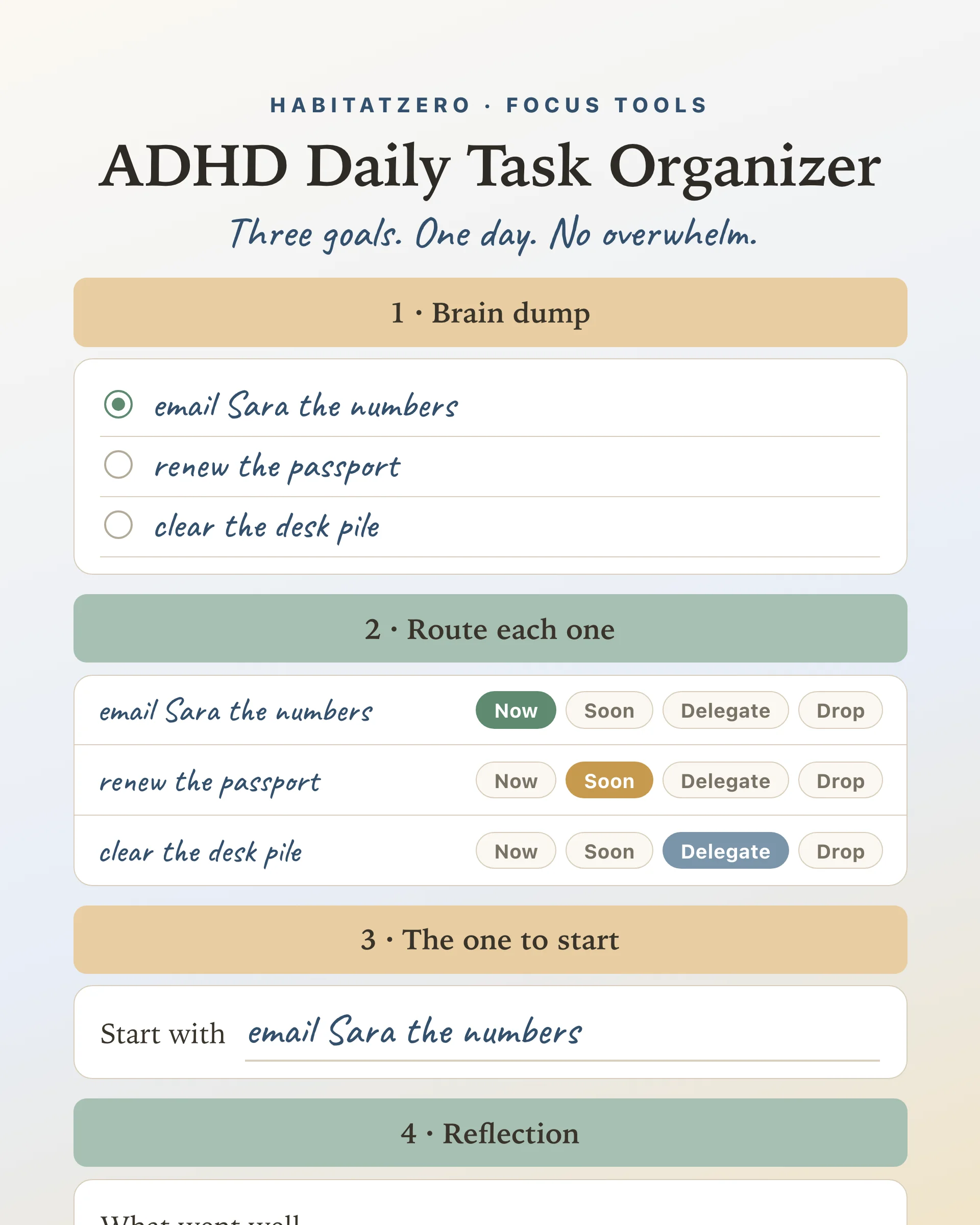
ADHD Daily Task OrganizerFocus & ADHD · ~10 min
About this template · Updated July 2026
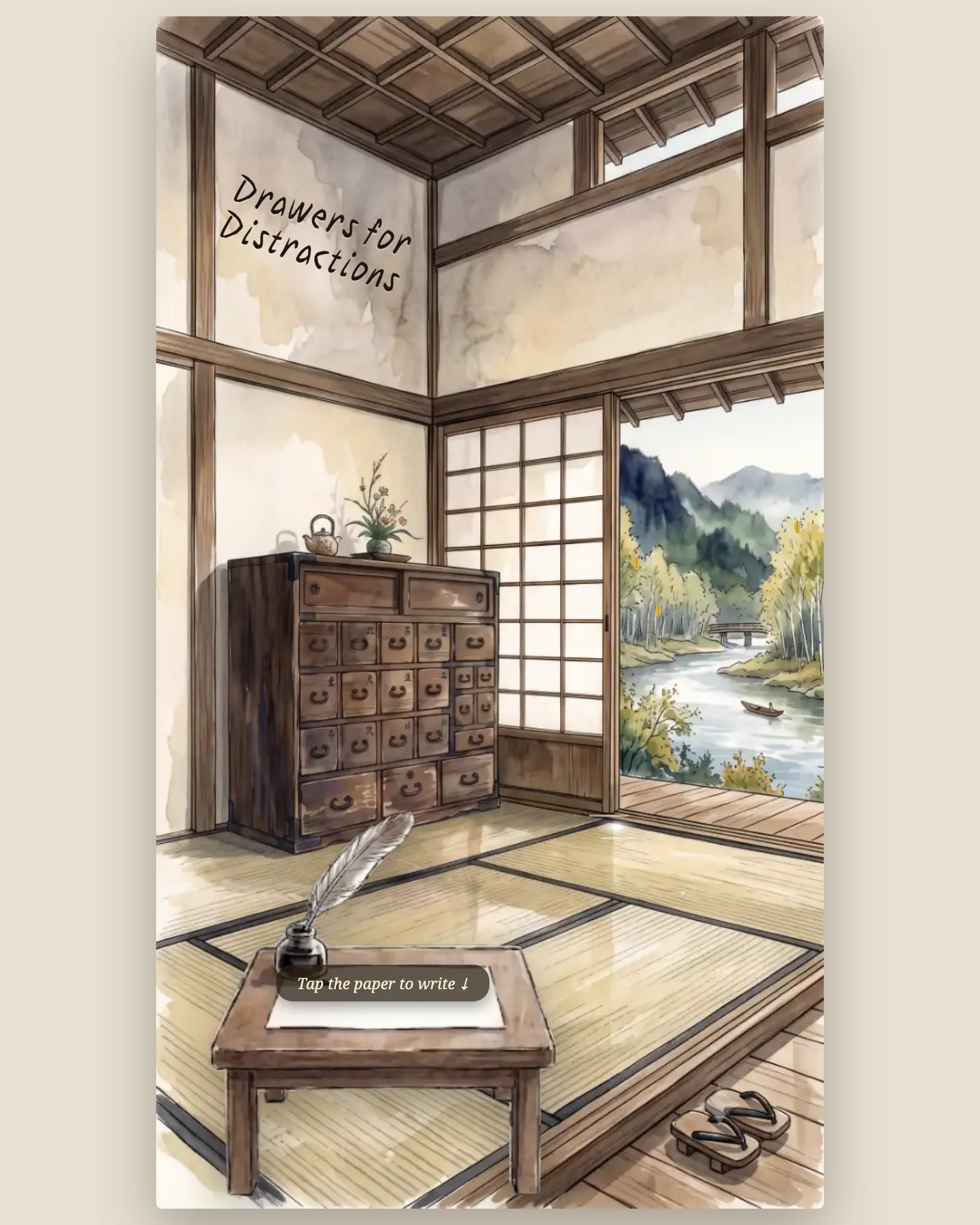
The old Buddhist image for a restless mind is a monkey swinging branch to branch — and the modern version swings between an unsent email, a dishwasher noise, and a sudden need to check flight prices, all before you finish a paragraph. This worksheet, built by Jazmin Quill as a quiet tatami room with a wooden tansu chest, does the one thing that reliably settles a monkey mind: it gives each swinging thought somewhere to land.
Tap the paper on the low writing table and name the thought pulling at you — precisely, not eloquently. One more tap and the paper rolls itself up and flies into the next empty drawer of the chest, which closes over it. That's the whole transaction: fifteen seconds, one distraction housed.
The animation is doing real work. An unwritten thought keeps a claim on your attention — it has to, since it exists nowhere else — and the research on attention is blunt about the cost: even a brief pull, the mere ping of a thing wanting attention, measurably fragments the task you're on. Writing the thought down ends its need to keep reminding you, and watching it physically leave the desk and land in a drawer is your attention witnessing the handoff. Ceremony, it turns out, is load-bearing.
Drawers with a marked pull hold thoughts. Tap one to unroll its note — deal with it, leave it, or discard it. Most drawers reopened after a work session turn out to hold five-minute errands, or nothing that still matters. That discovery, made weekly, is the actual cure for a monkey mind: the branches were mostly empty.
The chest holds twenty-one thoughts and no more. If you fill it, you don't have a distraction problem — you have a to-do list announcing itself, and the brain dump is the right room for that: everything out at once, sorted after. The drawers are the mid-task instrument: one thought, one drawer, back to work.
One paper on the table. One thought in your teeth. Write it, let it fly, and take your attention back.
The old Buddhist name for attention that swings from branch to branch — you sit down to work and the mind offers an errand, a worry, a thing to look up, each one grabbing the vine mid-sentence. The term is centuries old; the experience is every Tuesday. This page doesn't try to tame the monkey with discipline. It gives each swinging thought a drawer, because a thought with a safe place to sit stops needing your hands.
Because an unwritten thought has a job to do: it has to keep reminding you it exists, and even a tiny ping of it fragments the task you're on — the attention research on notifications found the pull costs you focus whether or not you act on it. Parking the thought somewhere you trust ends the reminding. The drawer is that somewhere, and the flying-paper ritual is your attention watching the handoff happen.
They wait. Tap a marked drawer any time to unroll the note, then do the thing, leave it for later, or discard it — many drawer-ed thoughts, revisited after the work session, turn out to be five-minute errands or nothing at all. The chest holds twenty-one; if you genuinely fill it, that's not failure, that's a to-do list announcing itself.
A to-do list is for things you intend to do; the drawers are for things you intend to stop thinking about. Some overlap, most don't — 'what if the demo fails' belongs in a drawer, not on a list. The other difference is the ceremony: a list line is bookkeeping, but a paper that rolls up and flies away is a small physical goodbye, and attention respects ceremony more than it respects bookkeeping.
Mid-task, the moment the tug starts — thirty seconds to drawer a thought beats twenty minutes of half-working while it circles. Some people also run a pre-focus sweep: two minutes before deep work, drawer everything that's already circling, then start clean.
By the team behind Fabulous, the science-based self-care app used by over 30 million people.