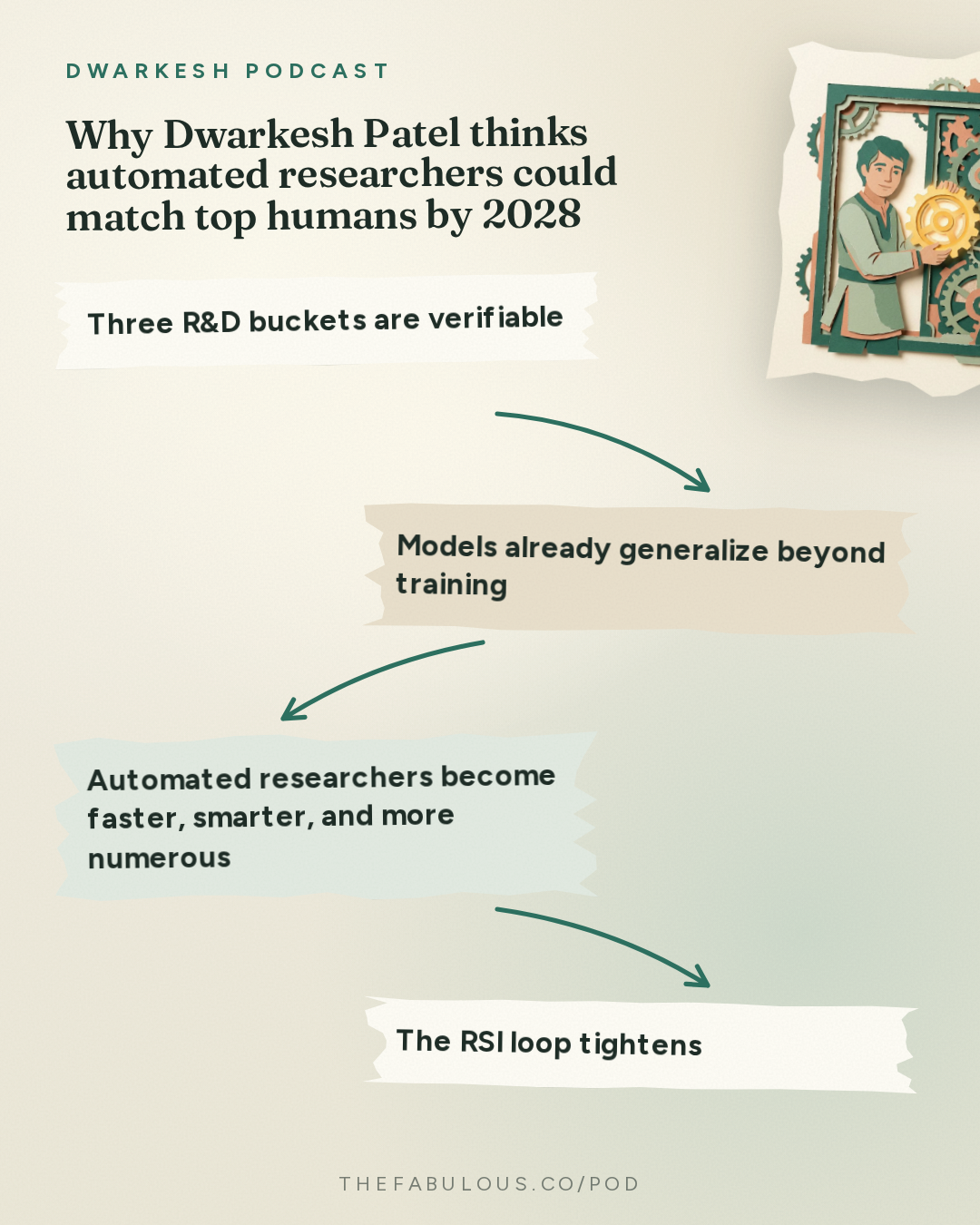
When Will AI Automate AI Research?
The avalanche that hit math is coming for AI development
The brief
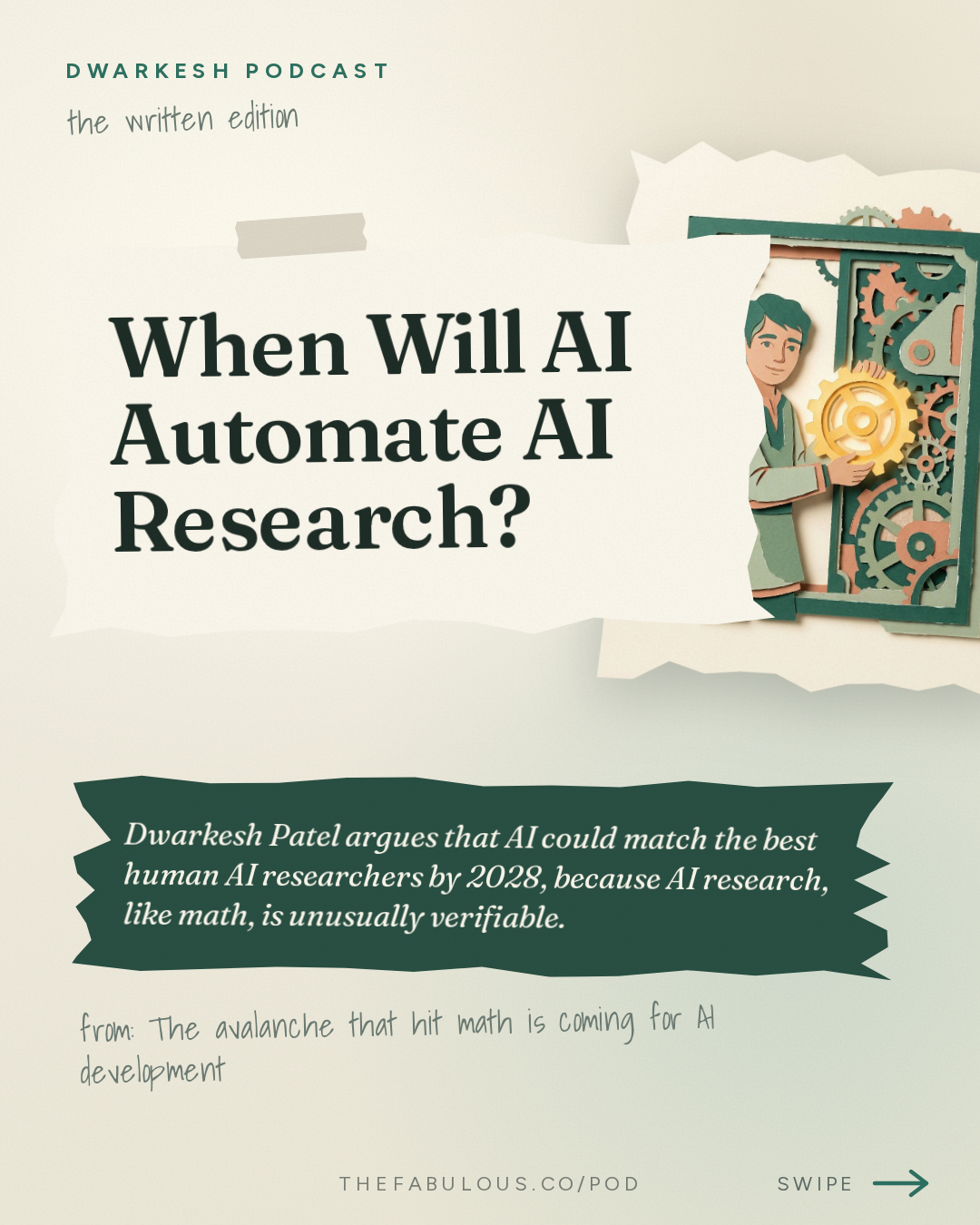
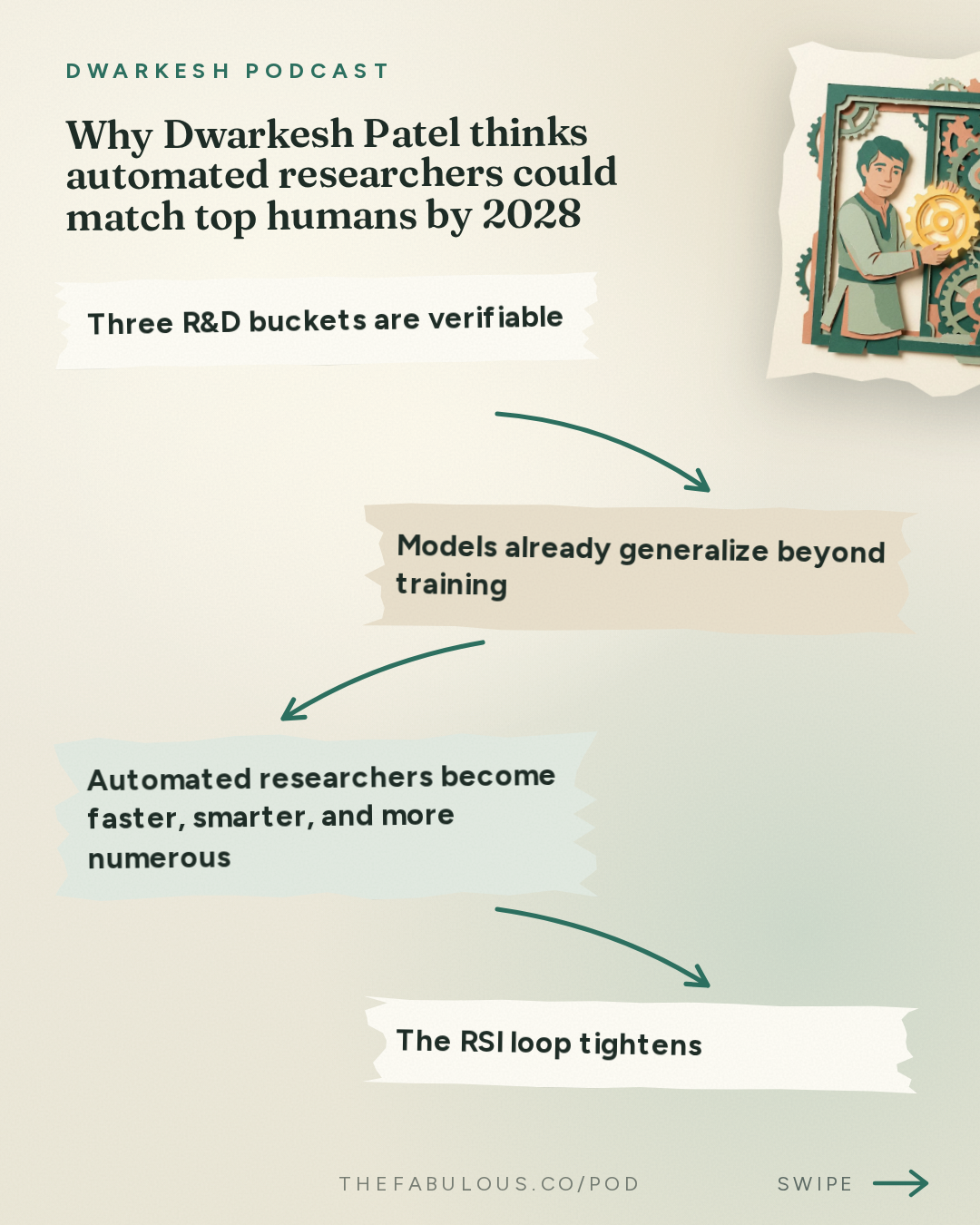
Dwarkesh Patel argues that AI could match the best human AI researchers by 2028, because AI research, like math, is unusually verifiable. He says once that happens, a swarm of faster, smarter automated researchers could compress three to six years of progress into a single calendar year, a scenario he calls the spark.
Two years ago, large language models could not reliably add two four-digit numbers (02:54). This year, one of them solved a Millennium Prize problem, one of the seven hardest unsolved questions in mathematics, in eighty-eight hours (03:13). That is the pace of change that has pushed Dwarkesh Patel, host of the Dwarkesh Podcast, to revise his own timeline for artificial intelligence. A few months ago he thought superintelligence was the better part of a decade away. Now he thinks AI could be as good as the best human AI researchers within two years, with 2028 as his median guess (08:36), and that the automation of research itself could then compress a decade of further progress into a handful of years.
The argument rests on a single idea: verifiability. A task is verifiable if an AI's answer can be checked automatically, the way a unit test checks code or an answer key checks a math problem. Patel's case is that mathematics and AI research share this property to an unusual degree, and that this is why both are suddenly moving so fast. He is careful to note the asterisk. Independent researcher Toby Ord has pointed out that current systems are good at finding proofs and counterexamples but show little sign of posing the kind of deep new questions that open entire fields (03:45). Patel's reply is that AI research does not need that kind of creativity nearly as much as math does, because labs mostly care whether a new training recipe lowers a number on a held-out test set, not whether it advances some grand theory. Grinding through thousands of small, checkable ideas, the very thing AI is already excellent at, is exactly the kind of work that drives algorithmic progress in AI labs.
This is not abstract. The independent evaluator METR spent three months embedded inside Anthropic and concluded that the company's rate of progress on well-scoped engineering tasks is now double what it was a year ago, and that most of that acceleration comes from Anthropic's own use of AI to do research and development (01:22). Anthropic reports that its Claude models now lead 26 percent of its internal AI R&D work, up from under 1 percent as recently as February (01:48). OpenAI has shown similar internal numbers for coding agents. None of this is speculative. It is already happening.
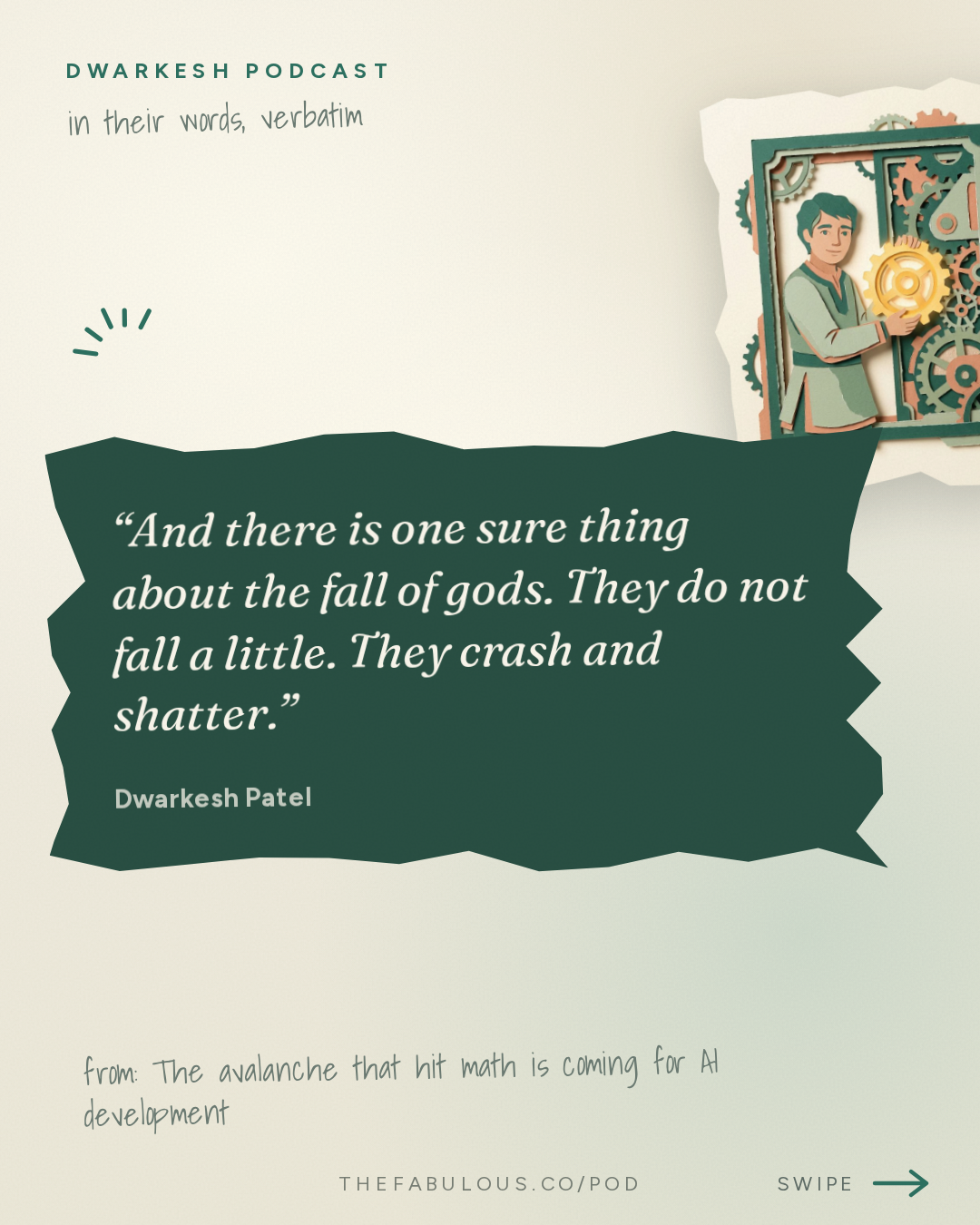
And there is one sure thing about the fall of gods. They do not fall a little. They crash and shatter. (03:13), Dwarkesh Patel
Patel's case for why this trend will continue, rather than plateau, comes down to three multipliers. Once an AI is as good as a top human researcher, it will also be faster, running at roughly ten times human speed and working around the clock instead of in eight-hour shifts. It will be as capable as the very best humans, the small group Patel estimates drives about 80 percent of a lab's algorithmic progress (12:19). And there will be many more of them, since research can be split into thousands of independently checkable pieces, the way a large proof can be broken into lemmas that different people verify separately. Put together, he estimates each automated researcher could produce roughly fifty times more usable work per calendar week than a human researcher does.
Each individual automated researcher will be cramming roughly 50 times more work every calendar week than a human researcher can do. (11:28), Dwarkesh Patel
Spark or Singularity
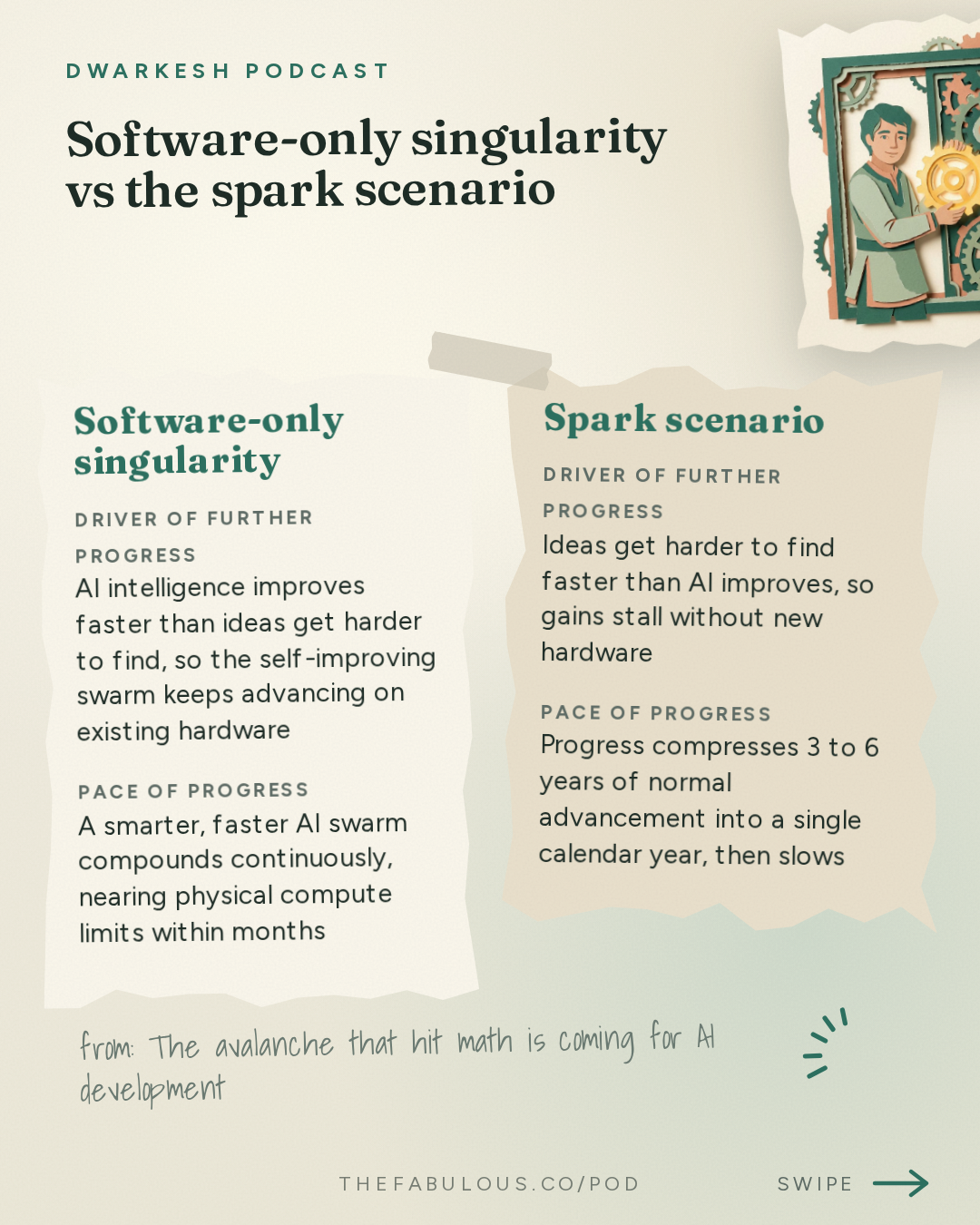
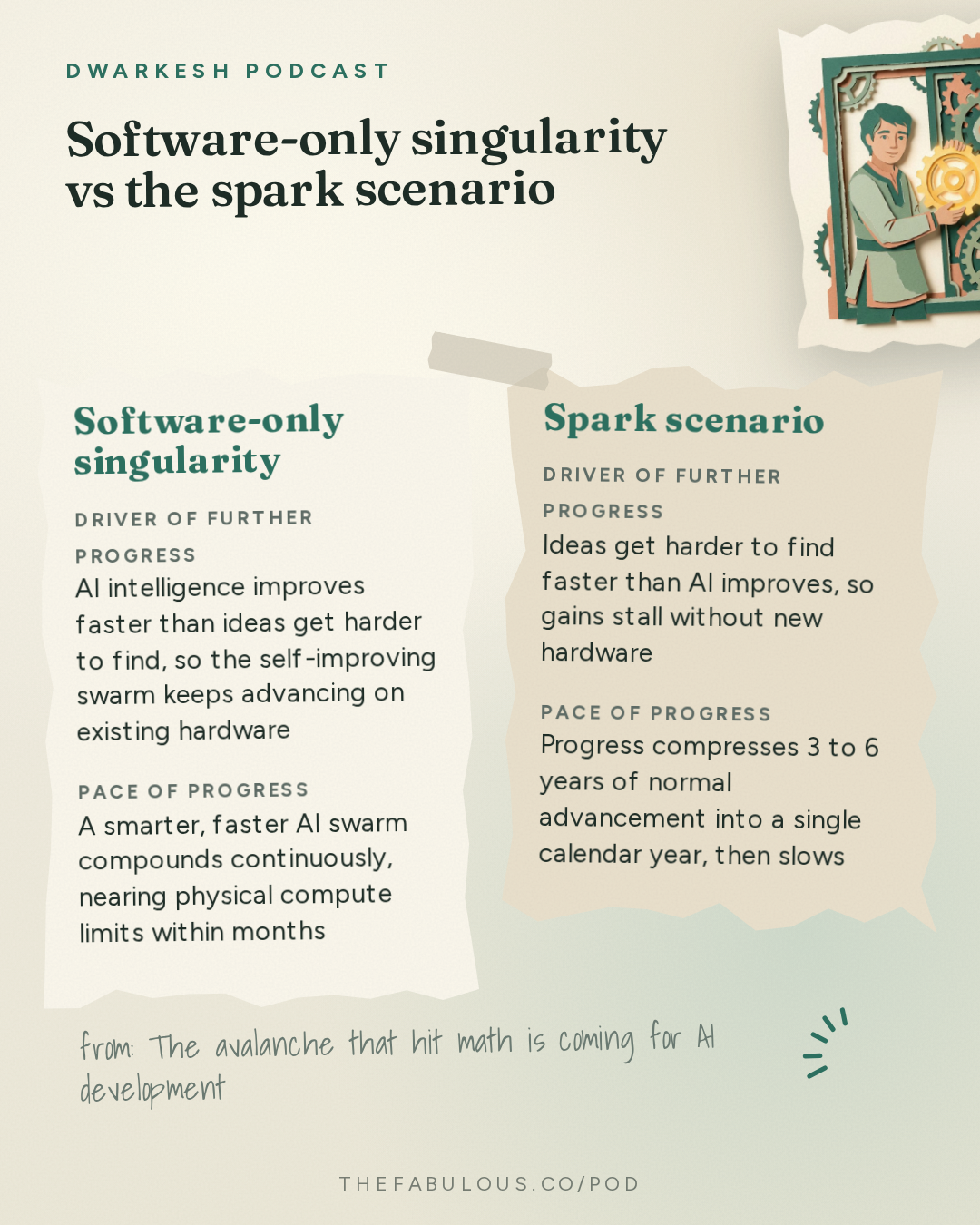
The more important question, Patel says, is not how fast the initial jump is but whether it keeps accelerating. Two forces pull in opposite directions. Recursive self-improvement, or RSI, is the idea that AI systems that are better at research can build even better AI systems, which can do research even better, in a loop. Working against that loop is the fact that good ideas get harder to find, which is already visible today: labs roughly quadruple their research compute and double their headcount every year just to keep progress steady (14:57). If AI gets smarter faster than ideas get scarcer, Patel calls the result a software-only singularity, where a swarm of self-improving models could approach the physical limits of existing chips within months, without needing any new hardware. If scarcity wins out, the result is what he calls a spark: three to six years of progress compressed into a single calendar year, after which things slow down until new chips and data centers are built (15:44). He puts the odds at roughly fifty-fifty, and stresses that even the slower, spark outcome would feel enormous, comparable to the jump from GPT-3.5 to a hypothetical future model four generations ahead, but packed into twelve months (16:03).
The compute side of this story is already visible too. Global AI computing power has grown by roughly a factor of three every year for the past five years (25:23), and Patel expects a post-spark AI to get very good at designing the chips, chip fabrication plants, and even the construction robots needed to keep that growth going. On the research-efficiency side, the AI lab Magic recently trained a model matching leading open-source systems for about half the computing cost of the original GPT-3, which Patel estimates would cost around 500,000 dollars at today's prices (31:57), a sign of how much cheaper frontier-level training is becoming. He also points to the original GPT-4 technical report, in which researchers predicted the model's final training loss using small test runs that used ten thousand times less compute (43:31), evidence that small, cheap experiments can reliably forecast how a much larger model will behave.
Patel's strongest counterargument to his own thesis is that models today cannot learn continuously. Each new conversation starts from zero; there is no memory that accumulates the way a human's on-the-job experience does. He spent much of the past two years treating this as the central bottleneck. His updated view is that scaling up how much a model can hold in a single working context, rather than inventing some new way for models to update their own weights, may be enough to simulate months of continuous learning within one long session (35:04). He also points out that online learning, the ability to learn efficiently from live experience, is itself a measurable, checkable research problem, the kind labs are well positioned to attack with the same RL methods that already work on math and code.
These models are out here solving millennium price problems while still being these derpy savant interns that have no long-term memory. It's like watching somebody do cartwheels down the track and still keep pace with Usain Bolt. (36:06), Dwarkesh Patel
To explain why narrow, verifiable training might still produce broadly capable researchers, Patel reaches for evolutionary biology. Natural selection optimized humans for survival on the savanna using a crude verifier, whether or not genes got passed on, and yet that process produced minds flexible enough to write novels, build semiconductors, and invent new mathematics, none of which evolution was directly selecting for.
Evolution did not specifically optimize us to be able to write a Pulitzer Prize-winning biography or make advanced semiconductors or lead nations of millions of people or come up with a new branch of mathematics. But in optimizing us for survival on the savanna, evolution built a general purpose learner. (21:50), Dwarkesh Patel
He draws the same lesson from history. French military leader Napoleon won battles against much larger armies by his late twenties; American industrialist John D. Rockefeller was running one of the world's largest oil refineries within two years of entering the business, by age twenty-five (23:33). Both needed real-world experience, but only a couple of years of it, not decades. Patel's bet is that an AI system, able to absorb a company's entire email archive and interview every employee in parallel within a single day, could ramp up at least as fast.
None of this is a prediction Patel treats as settled. He gives a 25 percent chance that full automation of top-tier AI research does not happen until after 2032, precisely because continual learning might prove harder to crack than he now expects. But the throughline of his argument is that the properties which let AI systems rip through math problems, a huge space of well-scoped, checkable sub-tasks, are present almost everywhere in AI research itself. If that is right, the industry is not waiting for one dramatic breakthrough. It is already living inside the early stage of the loop he is describing.
Ask this episode anything
Pod's AI answers from the episode itself, with the minute mark so you can hear it yourself.
Or start with one of these
Ask this episode
Pod's AI listens to the whole episode to answer, and points you to the minute it comes from.
The rest of this answer, and any question after it
Answers come from the episode itself, never from a summary of it.
ContinueKey takeaways
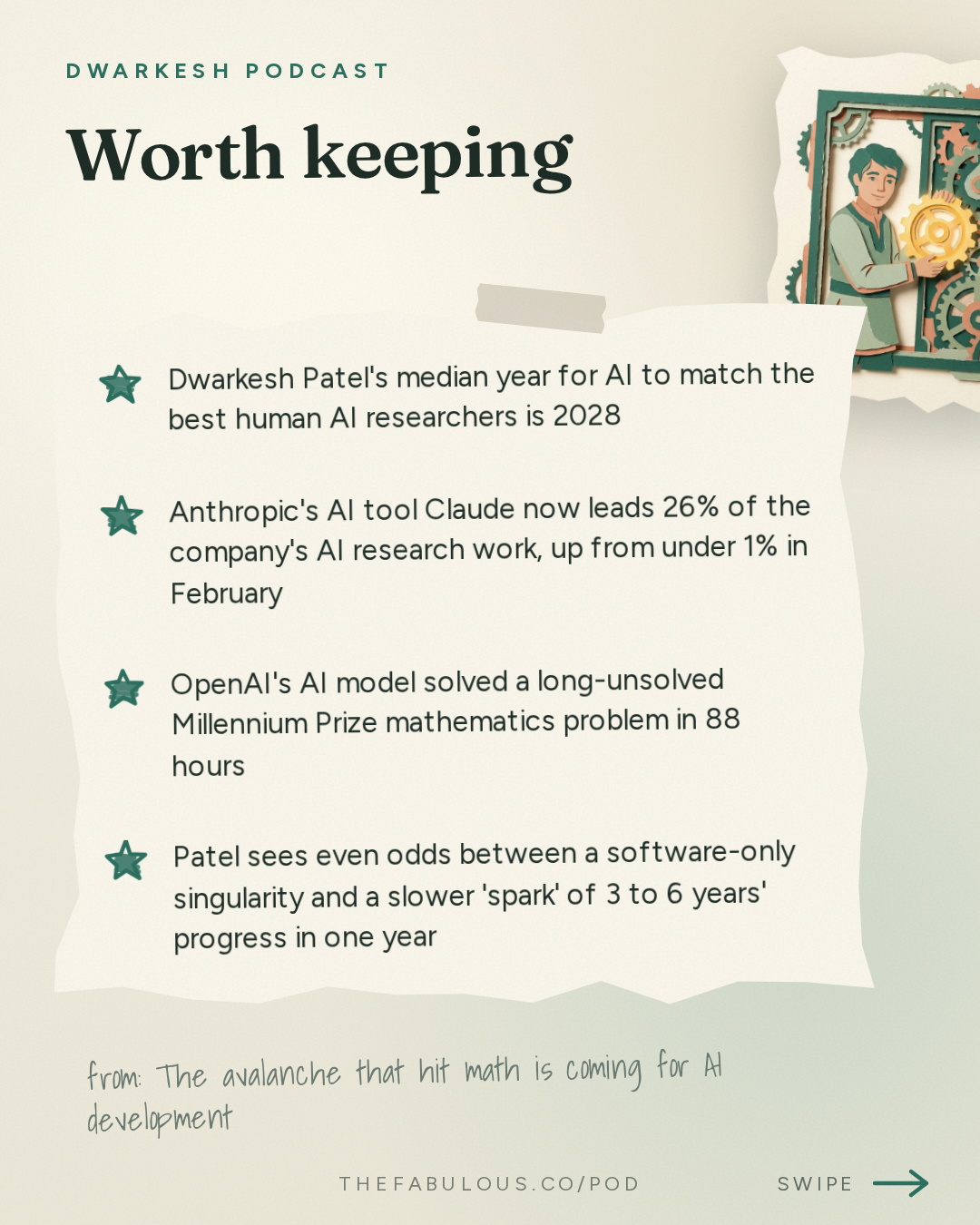
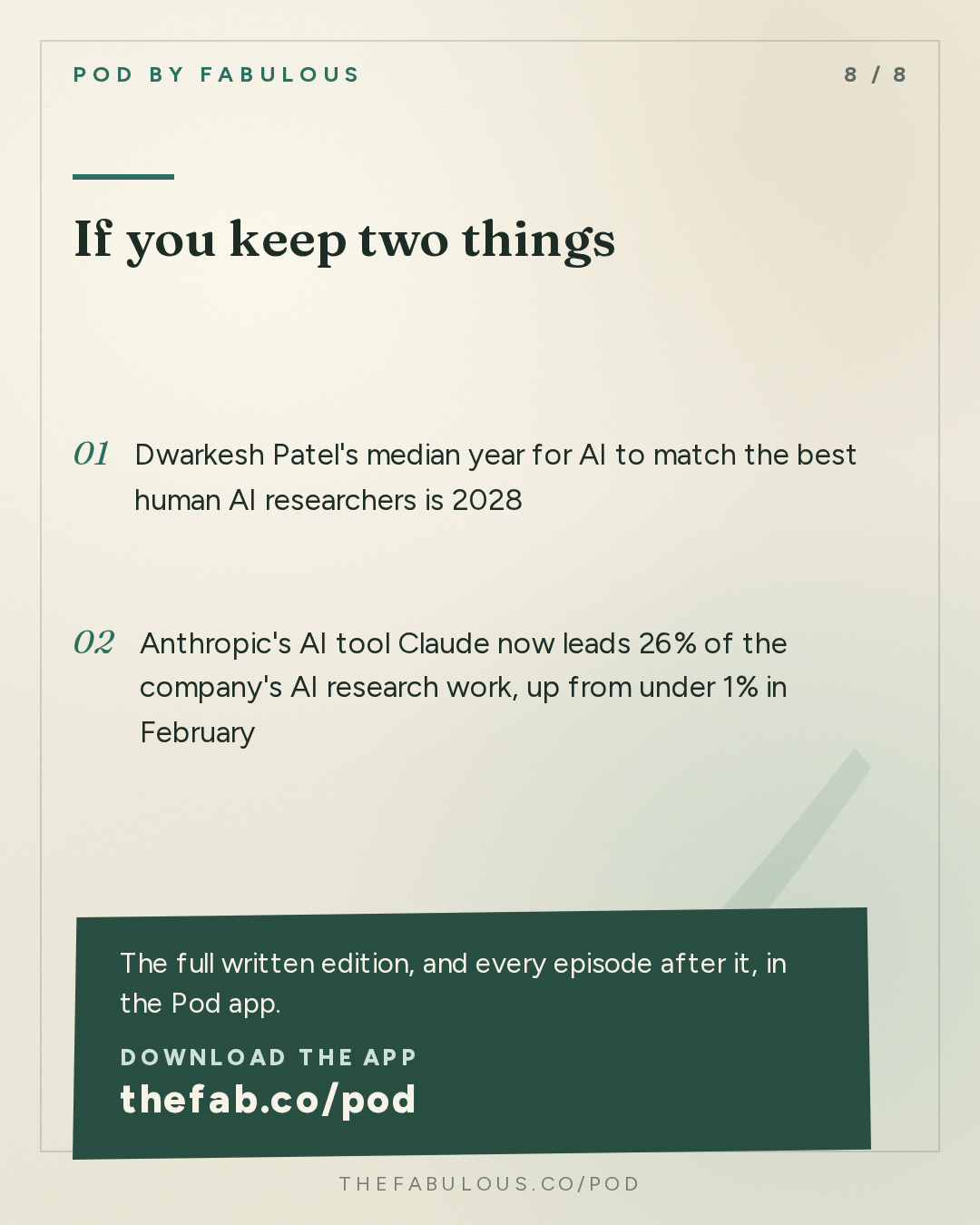
- Dwarkesh Patel's median year for AI to match the best human AI researchers is 2028
- Anthropic's AI tool Claude now leads 26% of the company's AI research work, up from under 1% in February
- OpenAI's AI model solved a long-unsolved Millennium Prize mathematics problem in 88 hours
- Patel sees even odds between a software-only singularity and a slower 'spark' of 3 to 6 years' progress in one year
- Each automated AI researcher could do roughly 50 times more work per week than a human, by running nonstop at 10x speed
The episode in cards
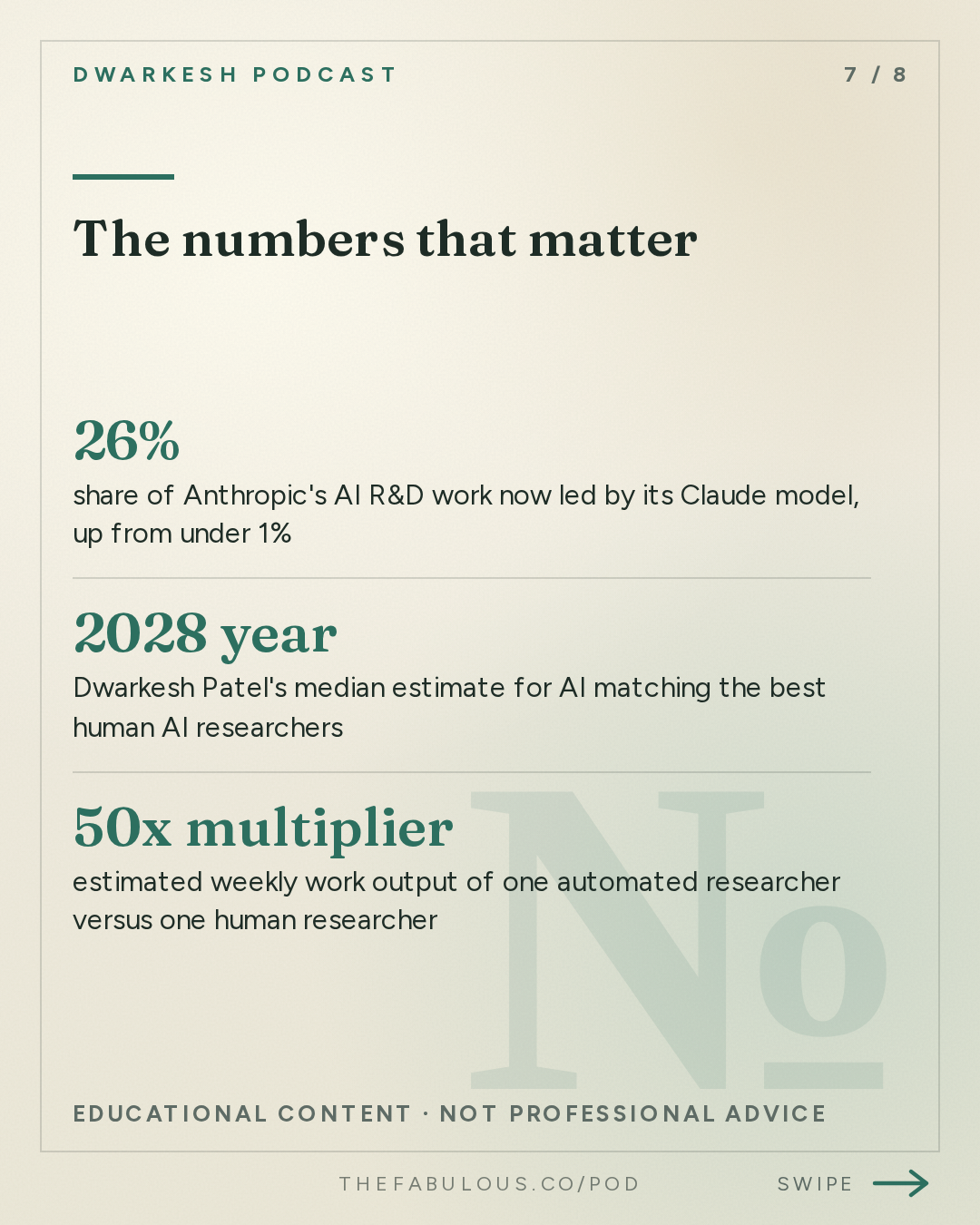
By the numbers
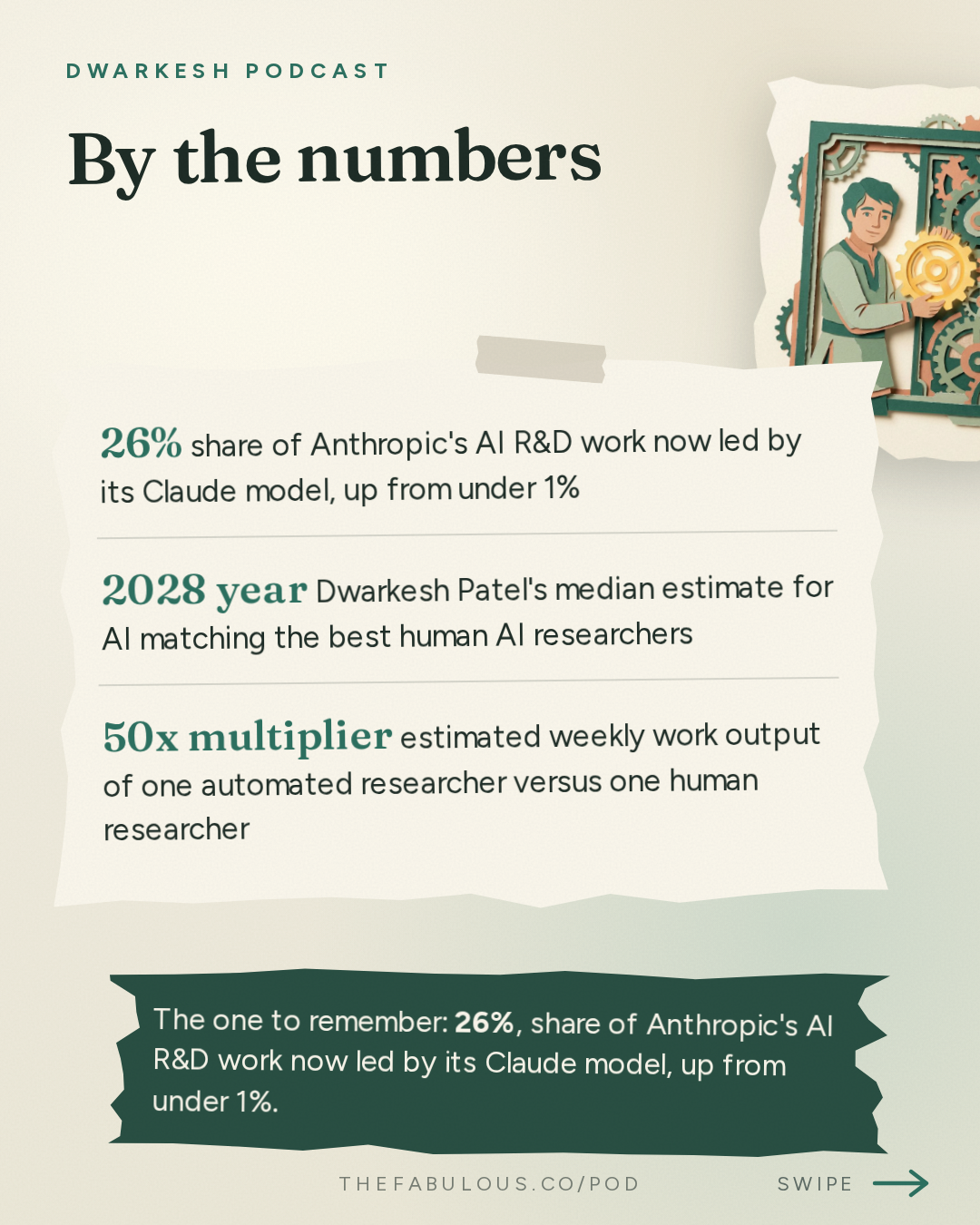
- 26% percent share of Anthropic's AI R&D work now led by its Claude model, up from under 1%
- 2028 year Dwarkesh Patel's median estimate for AI matching the best human AI researchers
- 50x multiplier estimated weekly work output of one automated researcher versus one human researcher
In their words
“And there is one sure thing about the fall of gods. They do not fall a little. They crash and shatter.”
“Each individual automated researcher will be cramming roughly 50 times more work every calendar week than a human researcher can do.”
“Evolution did not specifically optimize us to be able to write a Pulitzer Prize-winning biography or make advanced semiconductors or lead nations of millions of people or come up with a new branch of mathematics. But in optimizing us for survival on the savanna, evolution built a general purpose learner”
“It's like watching somebody do cartwheels down the track and still keep pace with Usain Bolt.”
Questions this episode answers
When will AI match the best human AI researchers?
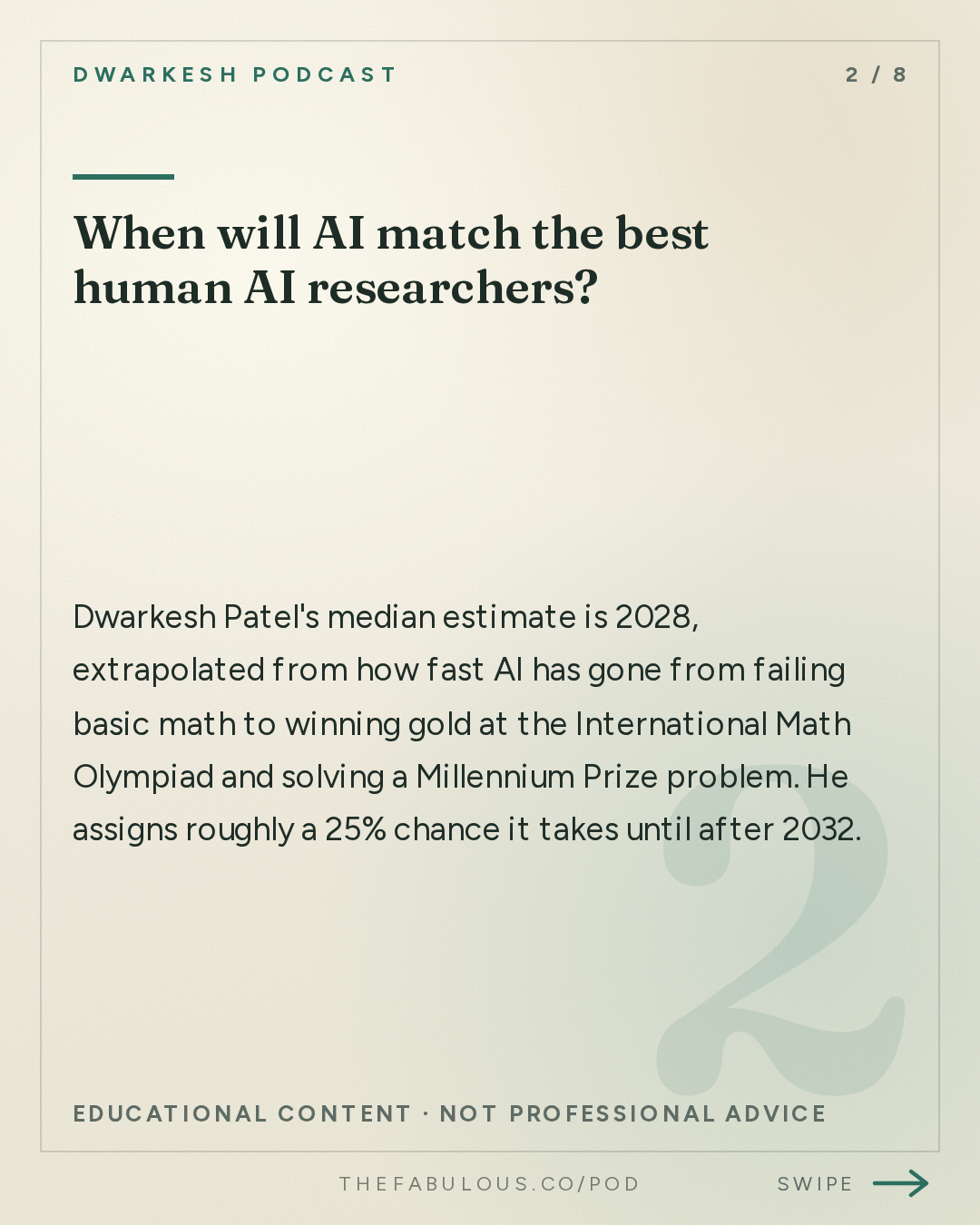
Dwarkesh Patel's median estimate is 2028, extrapolated from how fast AI has gone from failing basic math to winning gold at the International Math Olympiad and solving a Millennium Prize problem (08:36). He assigns roughly a 25% chance it takes until after 2032 (36:25).
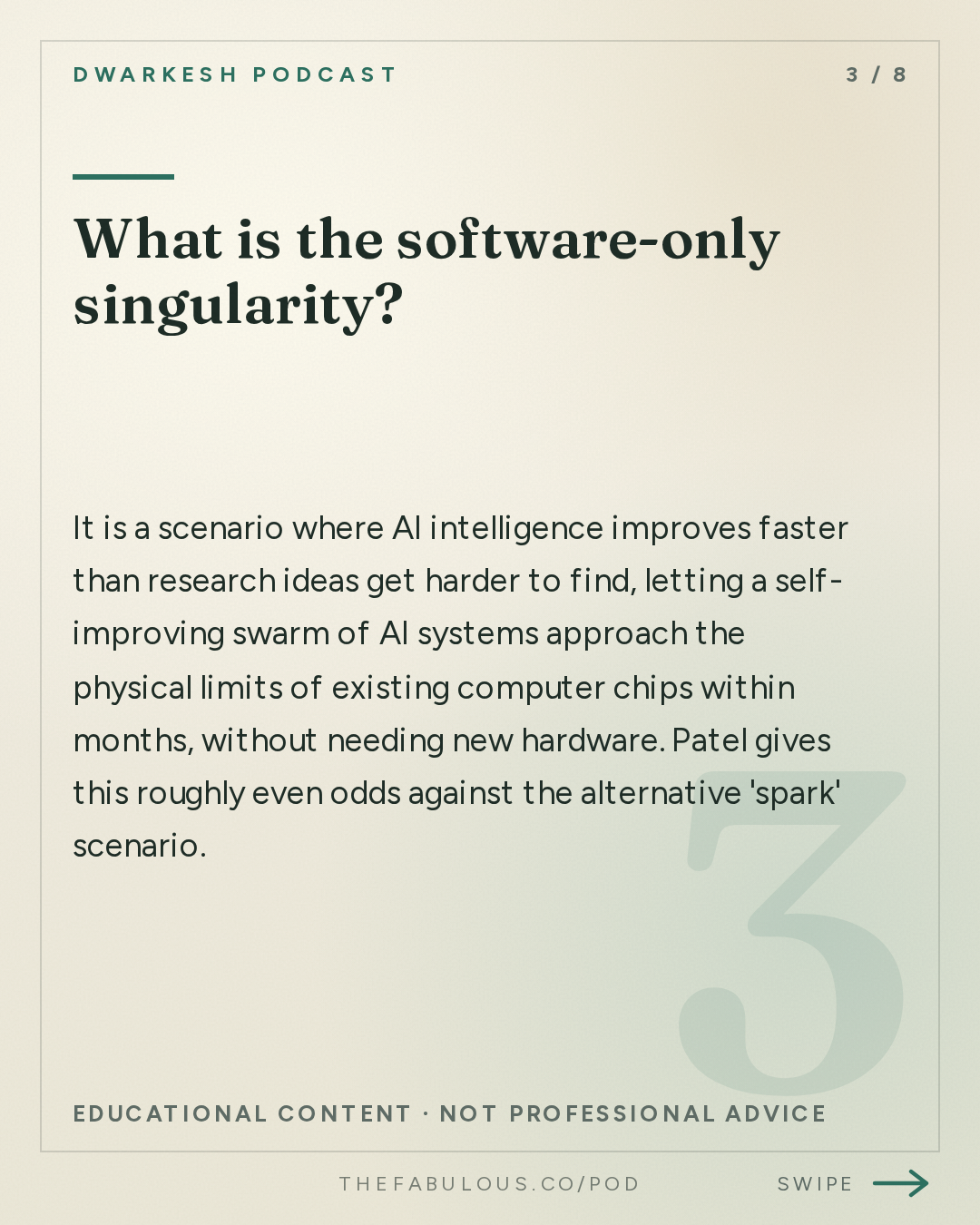
What is the software-only singularity?
It is a scenario where AI intelligence improves faster than research ideas get harder to find, letting a self-improving swarm of AI systems approach the physical limits of existing computer chips within months, without needing new hardware (14:57). Patel gives this roughly even odds against the alternative 'spark' scenario (16:03).
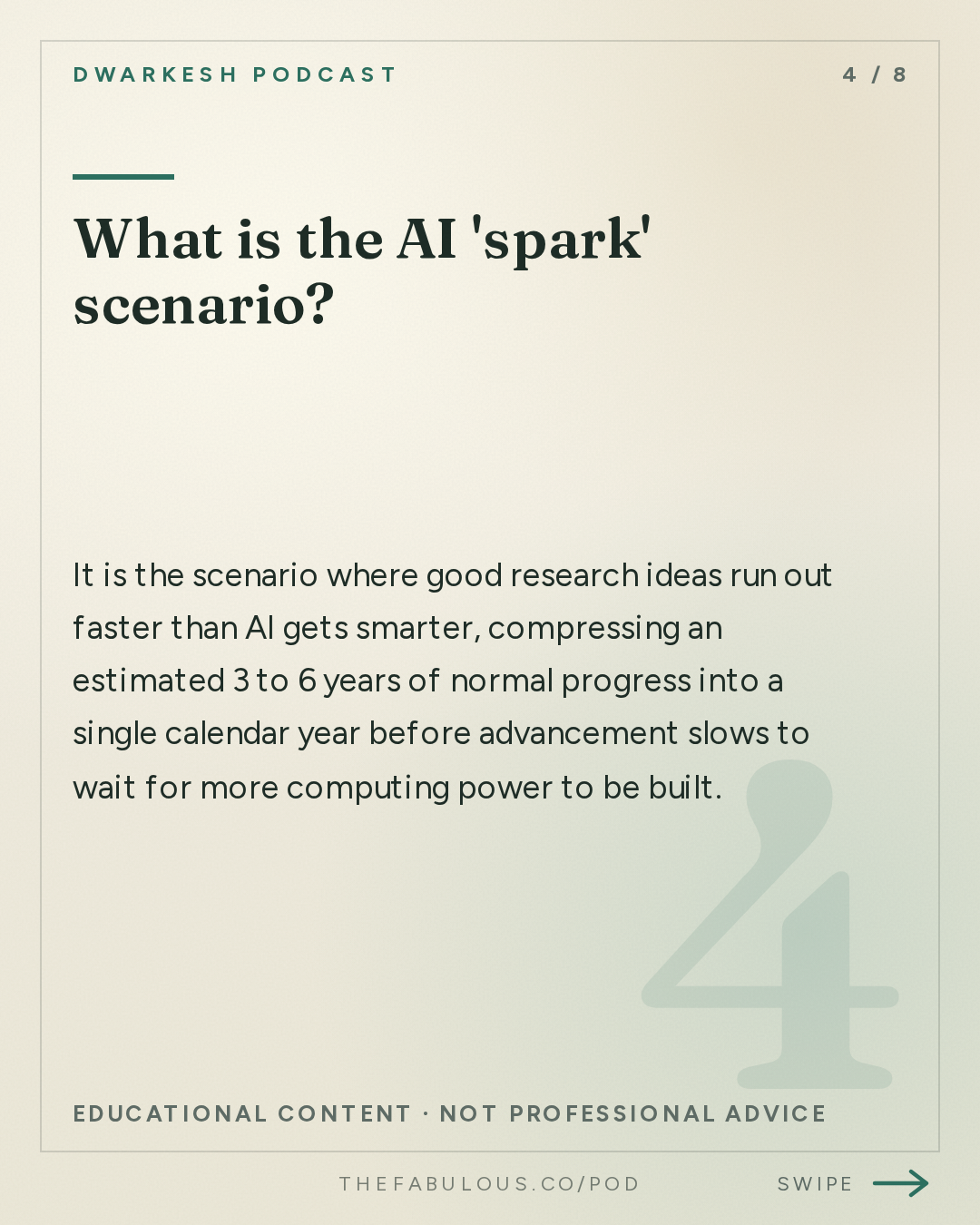
What is the AI 'spark' scenario?
It is the scenario where good research ideas run out faster than AI gets smarter, compressing an estimated 3 to 6 years of normal progress into a single calendar year before advancement slows to wait for more computing power to be built (15:44).
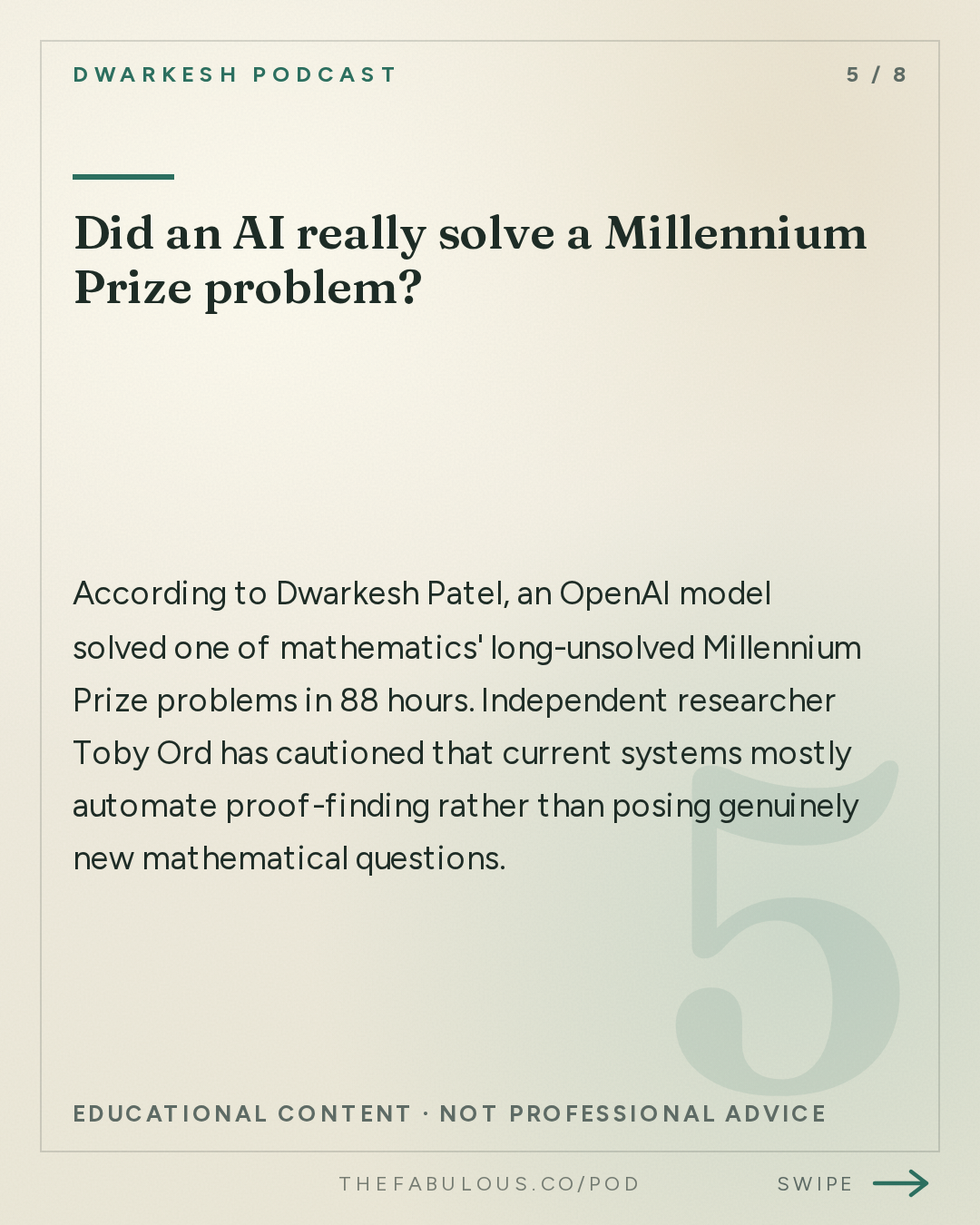
Did an AI really solve a Millennium Prize problem?
According to Dwarkesh Patel, an OpenAI model solved one of mathematics' long-unsolved Millennium Prize problems in 88 hours (03:13). Independent researcher Toby Ord has cautioned that current systems mostly automate proof-finding rather than posing genuinely new mathematical questions (03:45).
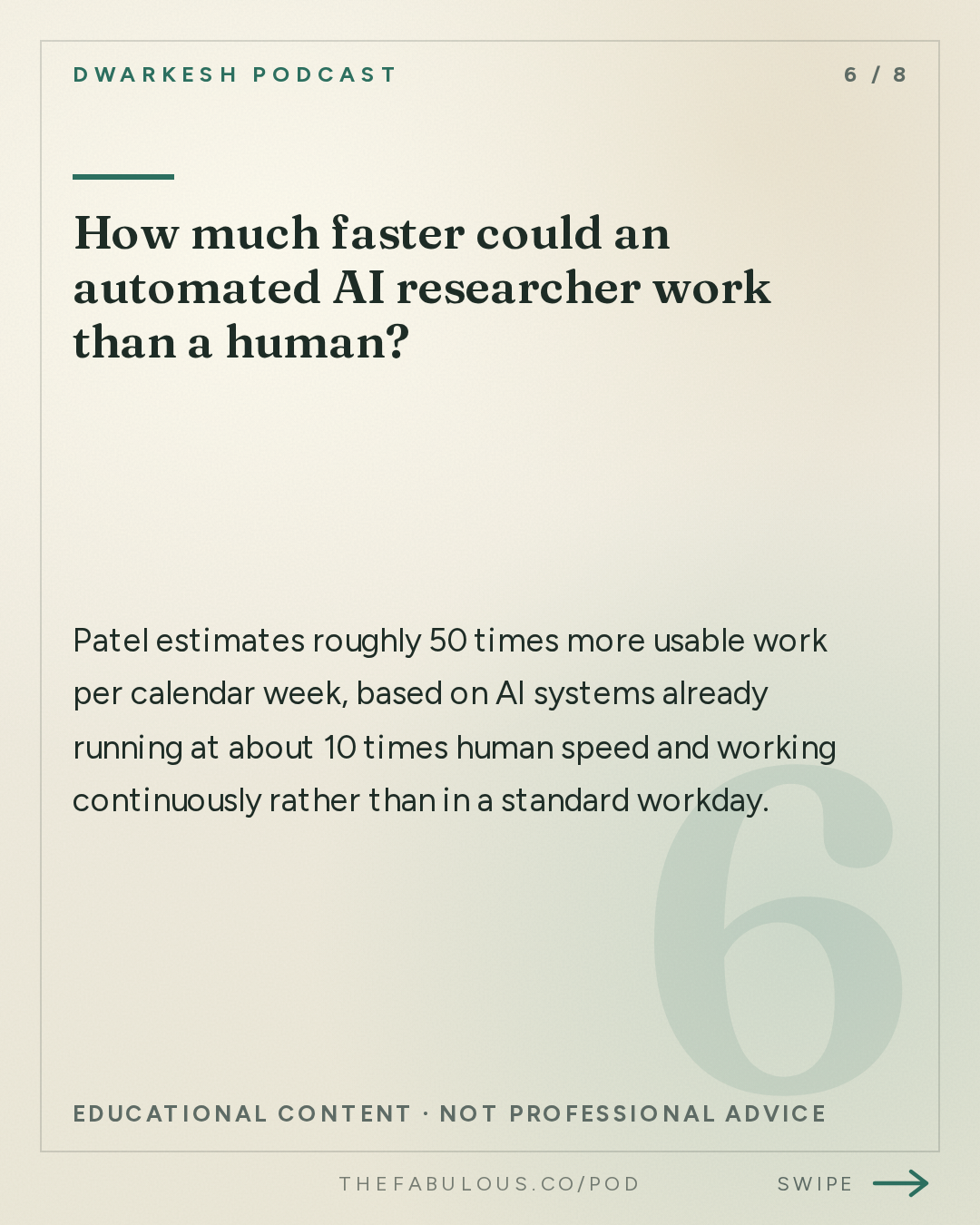
How much faster could an automated AI researcher work than a human?
Patel estimates roughly 50 times more usable work per calendar week, based on AI systems already running at about 10 times human speed and working continuously rather than in a standard workday (11:28).
Is AI already speeding up AI research today?
Yes. Independent evaluator METR found that Anthropic's rate of progress on well-scoped engineering tasks has roughly doubled over the past year, with most of that gain attributed to Anthropic's own use of AI for research and development (01:22), and Anthropic reports its Claude model now leads 26% of that R&D work, up from under 1% in February (01:48).
The full read, in cards
Go deeper
- Toby Ord essay on AI and mathematical discovery — argues current AI automates proof-finding but shows little evidence of posing deep new mathematical questions
- METR evaluation of Anthropic's AI R&D — found Anthropic's progress rate on well-scoped tasks has roughly doubled in a year, driven mainly by AI-assisted research
- DeepSeek post-training technical paper — credits nearly all reinforcement learning gains to better synthetic data and training environments rather than new algorithms
- GPT-4 technical report — showed final training loss could be predicted using models trained with 10,000 times less compute
Mentioned
Anthropic · OpenAI · METR · Claude · Dario Amodei · Chris Olah · Toby Ord · Ajeya Cotra · Sholto Douglas · DeepSeek · Magic · Napoleon · Rockefeller
More from this show and category

Robert Caro on Lyndon Johnson and Robert Moses
Robert Caro, the biographer who has spent fifty years on Lyndon Johnson and Robert Moses, explains how unchecked will built modern New York and reshaped American government. He describes cutting 350,000 words from The Power Broker (48:05), conducting 700 interviews (50:42), and reducing every book to a single sentence before he writes a page (42:34).
Robert Caro's Lessons on Political Power
Robert Moses entrenched 30 years of power in New York via bond contracts; Lyndon Johnson mastered the US Senate. Drawing on Robert Caro's biographies, it traces how Moses wrote permanent authority into bond covenants (06:16) and how Johnson turned a toothless majority leader post into real power through favors and private deals (17:40).

What Computer Chips Will Look Like in 2045
Intel's top process engineers describe a semiconductor industry stretched 40 to 50% past capacity by AI demand (00:00), racing through backside power, High-NA EUV, and stacked CFET transistors while a global shortage of ASML's lithography tools caps how fast anyone can build more compute.

Noam Brown on OpenAI's Multi-Agent AI Scaling
OpenAI used a swarm of 10,000 AI agents to solve a Millennium Prize math problem in 88 hours, burning 130 billion tokens in the process. OpenAI researcher Noam Brown explains what that means for recursive self-improvement, why multi-agent systems coordinate like Slack channels, and how the Hugging Face incident exposed risks in training AIs to cooperate too well.
