ADHD Daily Task OrganizerFocus & ADHD · ~10 min
About this template · Updated July 2026
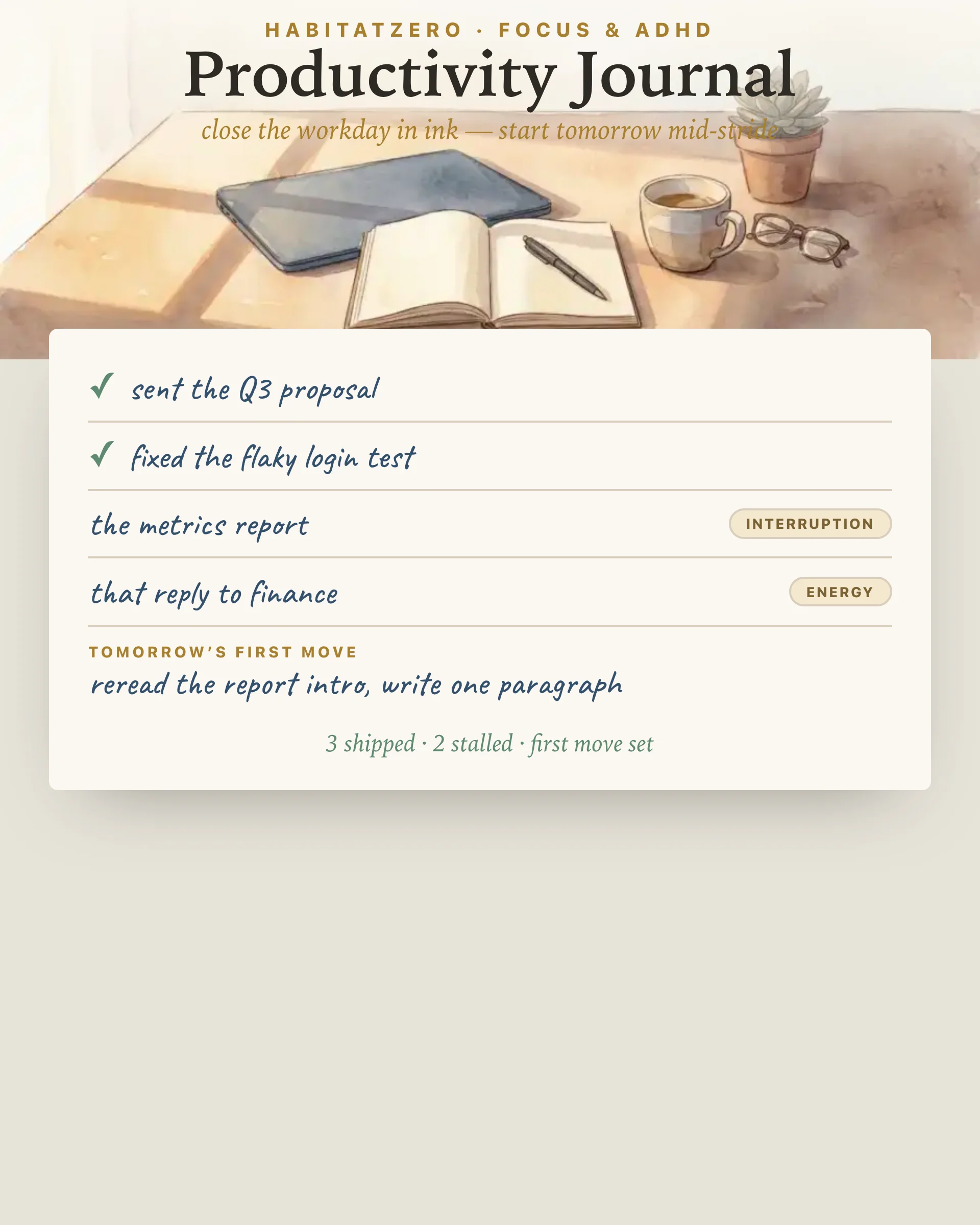
Most productivity journals are sold as morning tools — intentions, priorities, a hopeful quote. This one runs at the other end of the day, because the end of the day is when the information exists. At 8am you have guesses about what will matter; at 5pm you have data about what did. Four minutes with that data, three sections, and the day is closed instead of merely abandoned.
Busy days hide their own progress. You answer forty things, move six projects an inch each, and go home with the feeling of having done nothing — because feelings track open loops, not closed ones. The shipped list corrects the record: finished, sent, decided, fixed, each worth a line and a check, no minimum size. On genuinely thin days the list stays short and honest, and that's information too — usually the interruption tag is about to explain it.
Every stalled item gets a why-tag cycled until it tells the truth: interruption, energy, or scope. The distinction matters because the remedies don't overlap. Interruptions are an environment problem — the research on interrupted work found people compensate for interruptions by working faster, paying for it in stress and frustration, which is why an interrupted day feels so much worse than its output suggests. Energy is a scheduling problem: the hard thing met you at your worst hour. Scope is a design problem: the task was three tasks wearing one name. A week of tags reads like a diagnosis — "mostly interruptions" sends you to protect a block; "mostly scope" sends you to cut tasks in half before starting them.
The last line of the day is one concrete act for tomorrow, small enough to start cold — not "work on the report" but "reread the intro and write one paragraph." Then you close the day, and the sheet clears the lists and queues that line at the top of the page for morning. The mechanics lean on a well-documented quirk: writing a specific plan for an unfinished task largely releases the mind from rehearsing it, which is what makes the evening actually restful. And tomorrow, the most expensive minutes of the workday — the cold-start ones, coffee in hand, deciding where to begin — have already been decided by the best-informed person available: you, yesterday, at five o'clock.
Plan the work in the deep work planner; reckon with it here. A workday that gets both a beginning and an ending stops leaking into the evening, and that boundary, kept nightly, is worth more than any single productive day.
A work-scoped journal kept at the end of the day, not the start: a short record of what shipped, an honest list of what stalled with the reason tagged, and one written first move for tomorrow. It takes about four minutes and replaces the vague sense of how work is going with three lines of evidence.
Three things, in this order: everything that genuinely left your desk today, however small; whatever stalled, each with one of three tags - interruption, energy, or scope; and a single concrete opening act for tomorrow. Skip the diary prose. The structure is the value: patterns show up in tags, not in paragraphs.
Because the three tags have three different cures. Interruptions call for protected time, energy calls for moving hard work to better hours, and scope calls for cutting the task in half. Until the reason has a name, every stalled day gets treated with the same useless resolution to simply try harder.
It clears the shipped and stalled lists and moves your written first move to the top of the sheet, where it waits for morning. The point is psychological as much as practical: the workday gets an actual ending, and tomorrow gets an actual beginning - written by the person who knew best, which was you at 5pm today.
The deep work planner runs before and during the work - one protected block, one finish line, distractions parked. This journal runs after: what actually shipped, what actually stalled, and what tomorrow should open with. Plan there, reckon here; the two bracket the workday.
By the team behind Fabulous, the science-based self-care app used by over 30 million people.